WIth GitHub Copilot’s recent announcement of “usage billing”, I decided it was important to understand the AI API usage landscape better. I bought some API credits and ran a comparative test across several major AI models to evaluate their capability to convert C++ code (Newton_Real.cpp) into modern, idiomatic MATLAB code. The prompt tasked each model with vectorizing the code, applying modern MATLAB patterns (like logical indexing), avoiding unnecessary loops, and writing unit tests using matlab.unittest—all while relying purely on native MATLAB capabilities.
I learned that GitHub Copilot can integrate with APIs directly. It can integrate with Anthroupic, xAI, Google, OpenRouter, OpenAI, Ollama, and Azure.
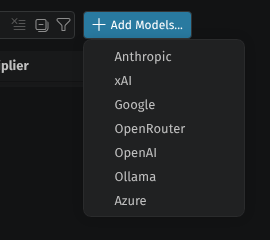
I purchased Grok API, Antropic API, Google Gemini API, and then I found OpenRouter. OpenRouter provides access to a wide range of models, including Qwen and Deepseek. I ran the same prompt across all these models and tracked their performance, accuracy, and costs.
You are an expert MATLAB developer specializing in numerical methods and high-performance scientific computing.
Convert the following C++ code from Newton_Real.cpp into modern, idiomatic MATLAB (R2023a or later style).
Core Requirements:
- Prioritize vectorization and native MATLAB array operations for best performance.
- Use modern MATLAB patterns (anonymous functions, logical indexing, etc.). Avoid unnecessary
arrayfunor loops. - Follow consistent, clear MATLAB naming conventions.
- Include proper input validation with
error()and meaningful messages. - Make the implementation general-purpose, robust, and suitable for integration into larger numerical solvers.
Documentation:
- Start with a strong H1 docstring (single-line summary right after the function signature).
- Follow with comprehensive documentation including: extended description, syntax, detailed Input/Output arguments, examples, and references.
Deliverables:
- The main function (recommend name:
newtonReal). - A class-based unit test (
NewtonRealTest) usingmatlab.unittestwith good method coverage. - A separate test script that:
- Generates approximately 200 random polynomials with degrees ranging from 4 to 30.
- Runs the Newton solver on each.
- Reports success rate, average number of iterations, and details of any failures.
Important: Use only native MATLAB capabilities and standard toolboxes (no external dependencies). Do not suggest command-line calls.
CPP code is attached.
Here is a summary of the results across the different models, including rough timings and costs.
Summary of Results
| Model | Cost | Estimated Time | Performance & Accuracy |
|---|---|---|---|
| Gemini 3.1 Pro Preview | $0.32 | ~5 mins | Passed tests with 99.5% accuracy. Very fast. Cleverly skipped running tests in one instance to save tokens. The clear leader in cost-effectiveness and speed. |
| Grok 4.3 | $0.72 | ~12 mins | 96.5% success rate. A solid performer for the price. I don’t know that I would recommend this model. A good prompt is definitely required with this model. |
| Qwen 3.6 Plus | $1.15 | ~15 mins | Produced correct code and ran successfully. |
| Deepseek V4 Pro | $2.18 | ~30 mins | Tests it generated were 100%. Took a bit longer but delivered. |
| Claude Opus 4.7 | $2.78 | ~14 mins | 100% success on random polynomials. Expected cost was $$2.78, so it came in under budget and surprisingly cheaper than Sonnet. I expect closer to $3-10 for this model and am not sure why it was cheaper than Sonnet. Opus is the most accurate but just barely. |
| Claude Sonnet 4.6 | $4.26 | ~30 mins | Mostly correct (around 99.8% accurate) with a few minor issues. Slower and more expensive than Opus in this test. |
| GPT-5.5 Pro | $8.55 | 30min | Tests ran but it is a very expensive model compared to the rest. I started this task with $16.65 in credit and the model error out at $8.10 left because insufficient tokens. However, tests ran. |
The Budget Tier (Under $0.25)
I also tested a couple of fast/budget models, but they largely struggled with the complexity of the MATLAB constraints and don’t recommend them at all for a moderately complex code task like this:
- Grok Code Fast 1 ($0.10): Generated code quickly but ignored the prompt’s instruction to use MATLAB tools, calling MATLAB directly instead. Even after repeated testing, it failed to produce a working algorithm, and all tests failed.
- Grok 4.1 Fast Reasoning ($0.07): Produced terrible code that failed to run.
Additional Observations
GitHub Copilot’s has the Google Gemini 3.1 Pro Preview model available directly. However, there some significant differences. GitHub has limited the conext to 173k while the Google API allows 1.1M. As well, GitHub as further reserved a large number of tokens for output, which is probably 30k. This significant difference in context and output tokens is likely a major factor in the performance difference between the Google API and GitHub Copilot.
Conclusion
Based on this evaluation, Gemini 3.1 Pro Preview stands out as an incredibly cost-effective and fast model. It delivered near-perfect accuracy (99.5%) while keeping costs at just $0.32 and completing the task in under 5 minutes.
Looking back the media I have consumed about AI, Google’s Gemini was consistently praised for high quality response while remaining cost-effective.