The Tangent Parabola
Source inspiration: (Mathew 2000-2019).
Animations
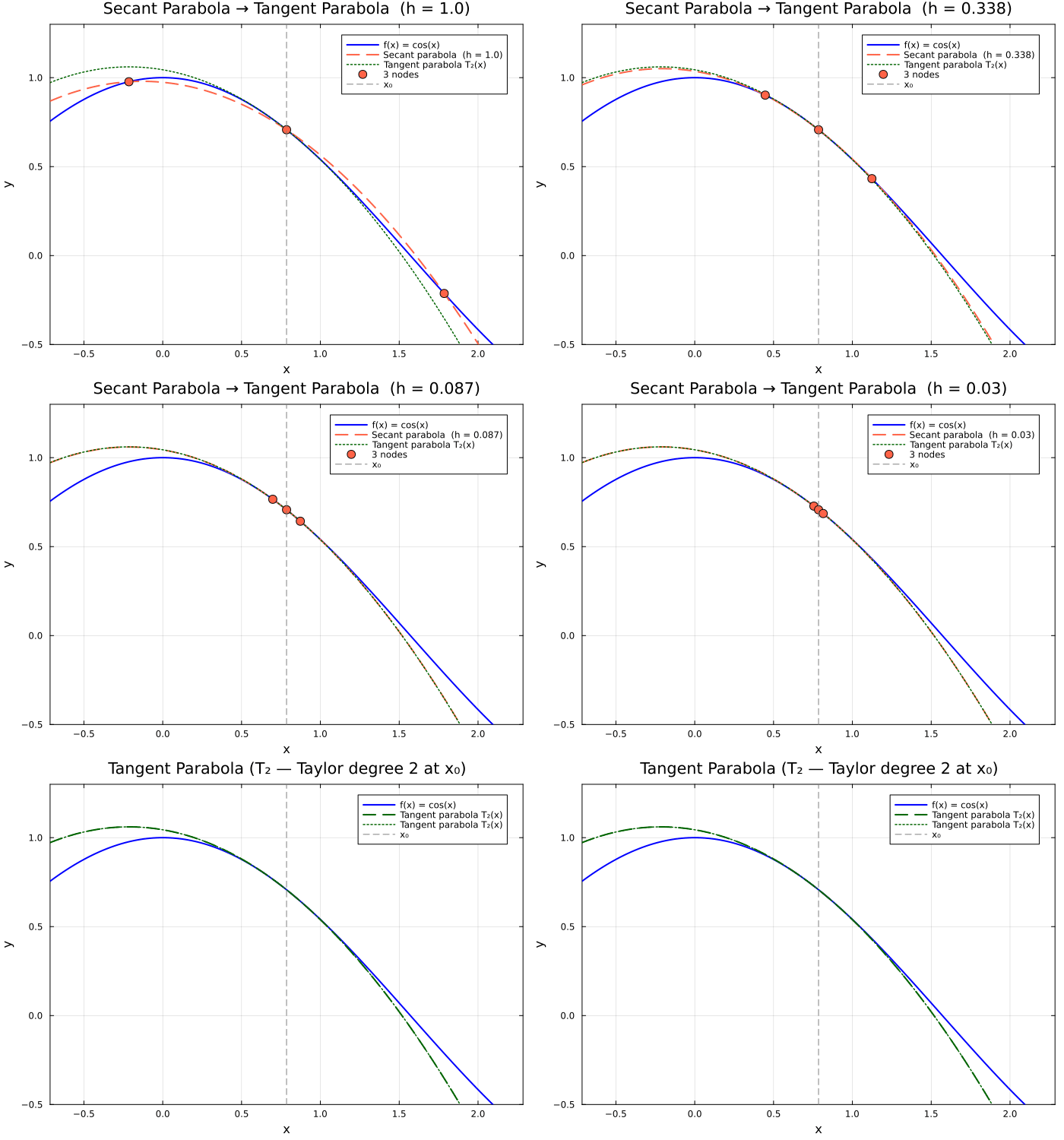
The animation below shows the secant parabola (degree-2 Newton polynomial through \(x_0 - h\), \(x_0\), \(x_0 + h\)) converging to the tangent parabola (degree-2 Taylor polynomial at \(x_0\)) as \(h \to 0\), for \(f(x) = \cos(x)\) centered at \(x_0 = \pi/4\).
Julia source scripts that generated these animations are linked under each case.
Case 1 — Secant parabola \(\to\) tangent parabola as \(h \to 0\), \(f(x) = \cos(x)\), \(x_0 = \pi/4\)
Behavior: For large \(h\) the secant parabola is determined by three well-separated points. As \(h \to 0\) all three nodes collapse to \(x_0\), and the secant parabola approaches the Taylor polynomial \(T_2(x) = f(x_0) + f'(x_0)(x-x_0) + \tfrac{1}{2}f''(x_0)(x-x_0)^2\) — the tangent parabola. This shows that the Taylor polynomial is the limiting position of the Newton interpolating parabola.
Derivation Notes (Planned)
Short derivations will be added to explain the core equations and assumptions.