Shooting Methods for ODE’s
Source inspiration: (Mathew 2000-2019).
Description
The shooting method converts a two-point boundary value problem into one or more initial value problems. For linear second-order equations, we solve two IVPs, \(u(t)\) and \(v(t)\), then combine them so the right-end boundary value is matched exactly.
For
\[ x'' + p(t)x' + q(t)x = r(t), \quad x(a)=\alpha, \quad x(b)=\beta, \]
the linear shooting reconstruction is
\[ x(t)=u(t)+\frac{\beta-u(b)}{v(b)}\,v(t), \]
where \(u(a)=\alpha,\;u'(a)=0\) and \(v(a)=0,\;v'(a)=1\). This gives a direct boundary-satisfying solution once \(u\) and \(v\) are known.
Animations
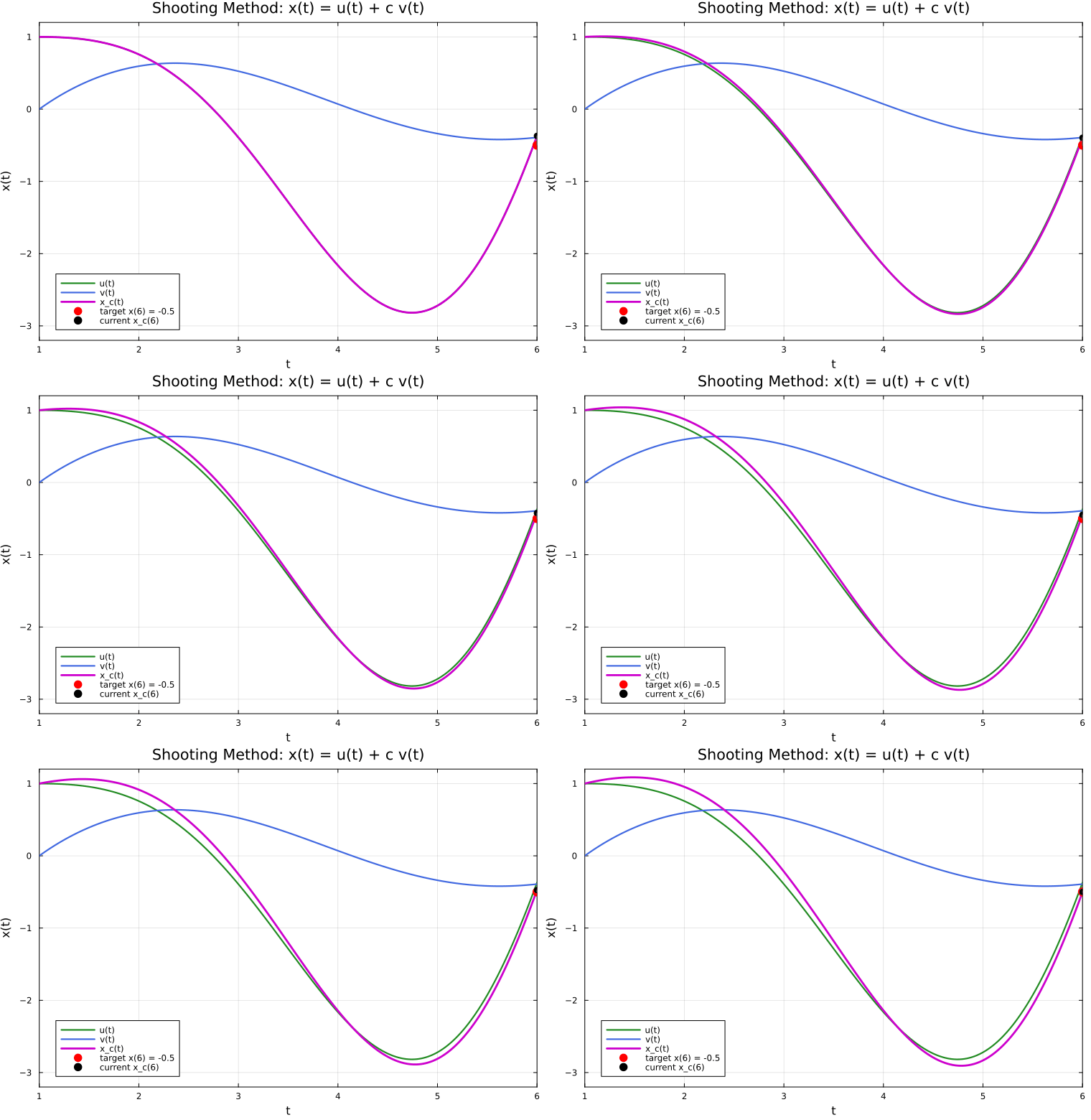
The animation below uses the legacy module’s Example 1 boundary value problem:
\[ x'' + \frac{1}{t}x' + \left(1-\frac{1}{4t^2}\right)x = \sqrt{t}\cos(t), \quad 1\le t\le 6, \quad x(1)=1, \quad x(6)=-0.5. \]
Legacy archive note: this topic’s recovered assets are formula and static graph GIFs; no dedicated pre-rendered legacy animation GIF was found, so the motion is reconstructed from the worked-example equations and graph geometry.
Case 1 - Linear shooting combination, \(x(1)=1\), \(x(6)=-0.5\)
Behavior: The frame sequence keeps \(u(t)\) and \(v(t)\) fixed and varies the coefficient \(c\) in \(x_c(t)=u(t)+c\,v(t)\) until the endpoint hits the target \(x(6)=-0.5\). This visualizes the core linear-shooting correction \(c=(\beta-u(b))/v(b)\).
Derivation Notes (Planned)
Short derivations will be added to explain the core equations and assumptions.
Worked Example (Planned)
The exact symbolic solution and a side-by-side numeric comparison will be added.
Implementation Notes (Planned)
Implementation details, numerical stability notes, and practical pitfalls will be added.