Runge-Kutta-Fehlberg Method
Source inspiration: (Mathew 2000-2019).
Description
The Runge-Kutta-Fehlberg method (RKF45) is an adaptive-step one-step solver for initial value problems. At each step it computes embedded 4th- and 5th-order approximations from the same stage evaluations, estimates local error from their difference, and then adjusts step size to meet a tolerance.
If \(y_4\) and \(y_5\) are the embedded updates, then a practical error estimate is \(|y_5 - y_4|\). The next step size is chosen using a scaling rule of the form \(h_{new} = s h\) with \(s \propto (\varepsilon/\text{err})^{1/4}\), where \(\varepsilon\) is the requested tolerance.
Animations
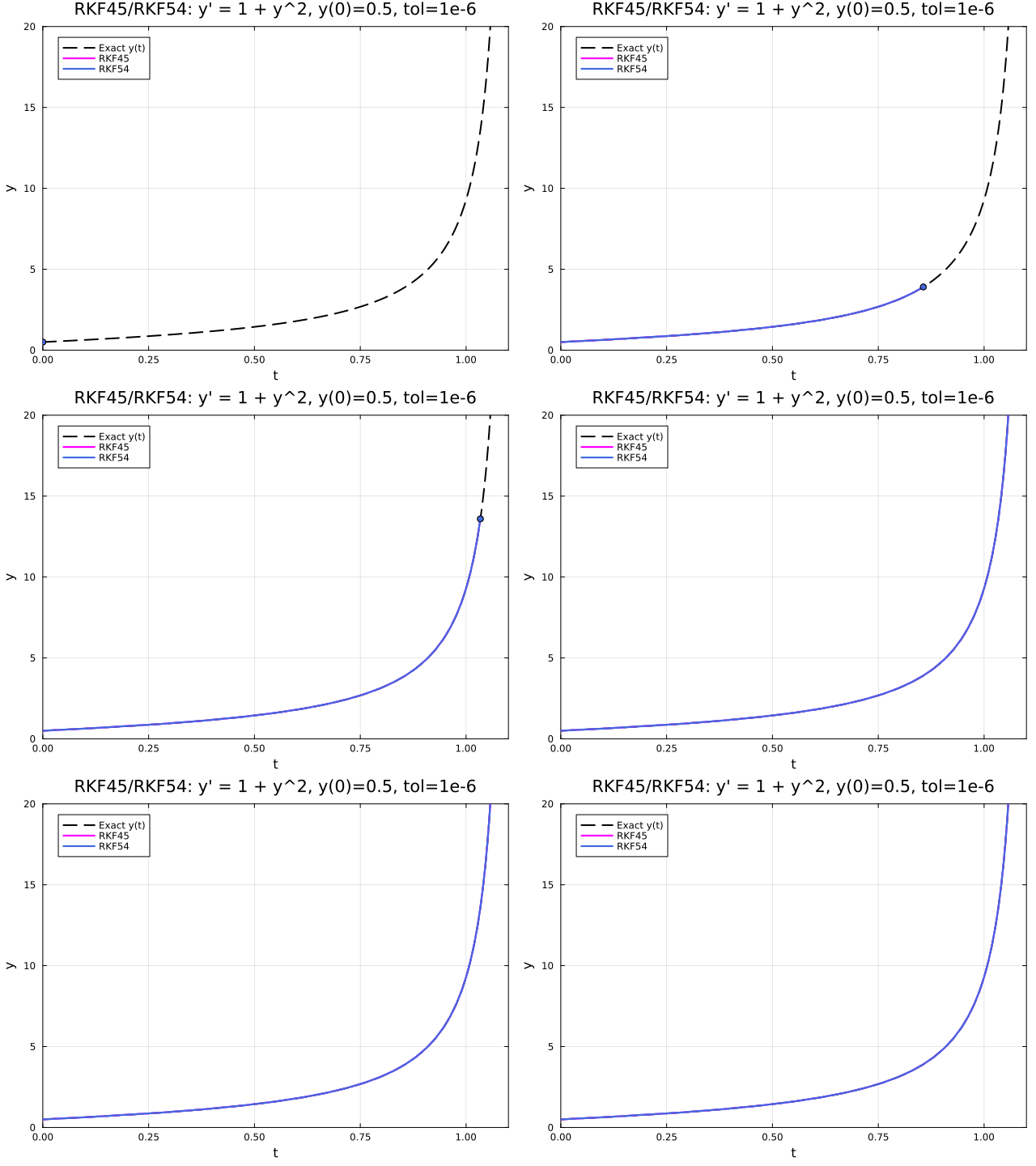
The first animation below reconstructs the legacy Example 1 setup from the Mathews module: \(y' = 1 + y^2\), \(y(0)=0.5\), on \([0,1.1]\). The dashed black curve is the exact solution \(y(t)=\tan\!\left(t + \arctan(0.5)\right)\).
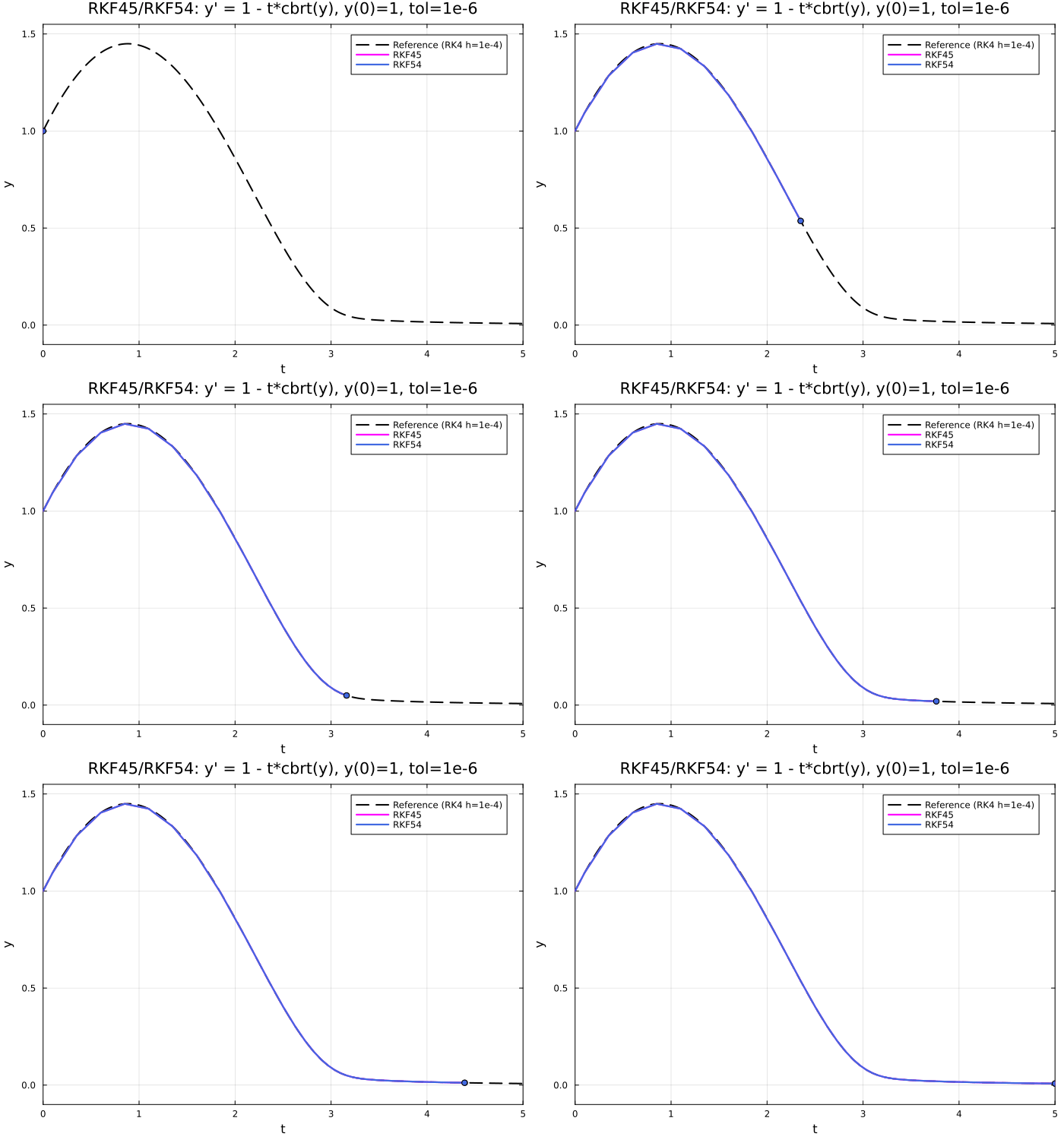
The second animation uses the same IVP shown on the Adams-Bashforth-Moulton, Euler, and Modified Euler pages: \(y' = 1 - t\sqrt[3]{y}\), \(y(0)=1\), on \([0,5]\), with a dashed high-accuracy reference trajectory from fixed-step RK4 at \(h=10^{-4}\).
Because the recovered archive did not include legacy RKF animated GIF portals for this topic, this animation is reconstructed from the worked-example equations and plot behavior in the module links/images.
Case 1 - Adaptive RKF45 vs RKF54, \(y' = 1 + y^2\), \(y(0)=0.5\), \(t \in [0,1.1]\)
Behavior: Both adaptive traces follow the exact solution well while the curve rapidly steepens near \(t=1.1\). The accepted-step distributions differ slightly, reflecting the 4th-order vs 5th-order accepted update choice.
Case 2 - Adaptive RKF45 vs RKF54, \(y' = 1 - t\sqrt[3]{y}\), \(y(0)=1\), \(t \in [0,5]\)
Behavior: RKF45 and RKF54 closely follow the dashed RK4 reference trajectory, with only small visible differences as adaptive steps tighten through the steeper part of the solution.
Derivation Notes (Planned)
Short derivations will be added to explain the core equations and assumptions.
Worked Example (Planned)
A compact numerical example with intermediate steps will be included.
Implementation Notes (Planned)
Implementation details, numerical stability notes, and practical pitfalls will be added.