Romberg Integration
Source inspiration: (Mathew 2000-2019).
Description
Romberg integration accelerates composite trapezoidal approximations with Richardson extrapolation. If \[ R_{k,1}=T_{2^{k-1}}, \] then higher columns are formed by \[ R_{k,j}=R_{k,j-1}+\frac{R_{k,j-1}-R_{k-1,j-1}}{4^{j-1}-1}, \qquad j=2,\dots,k. \]
This builds a triangular table whose diagonal entries converge quickly for smooth integrands, often outperforming raw trapezoidal refinement for the same function evaluations.
Animations
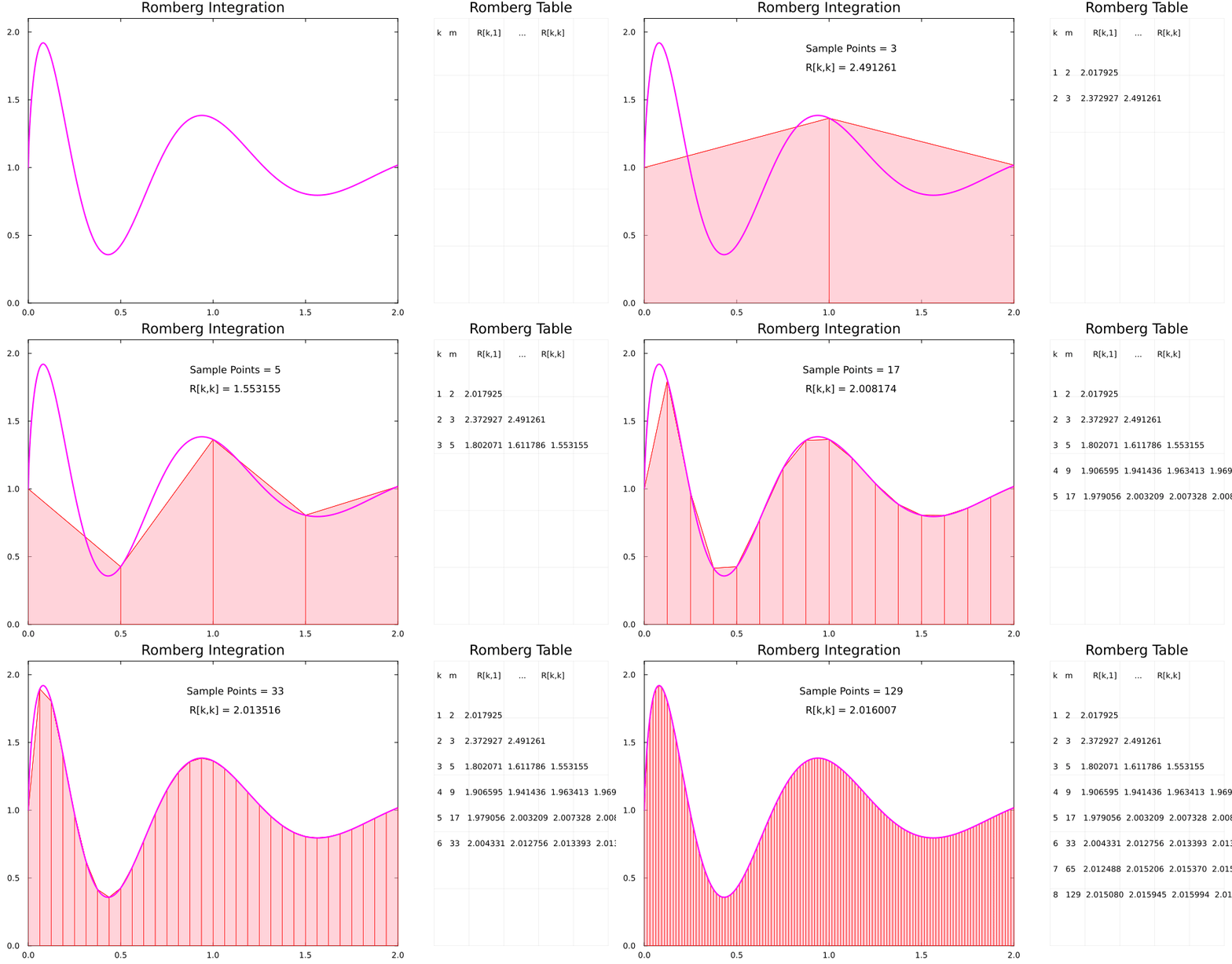
Each animation below shows the Romberg refinement process for \(f(x)=1+e^{-x}\sin(8x^{2/3})\) on \([0,2]\). The graph and table are updated together as the trapezoidal mesh is globally refined with sample counts \(m=2,3,5,9,17,33,65,129\).
Julia source scripts that generated these animations are linked under each case.
Case 1 — Romberg Table Construction, \(f(x)=1+e^{-x}\sin(8x^{2/3})\), \([0,2]\)
Behavior: Each frame adds one Romberg row from a denser trapezoidal partition and then applies Richardson extrapolation across the row. The diagonal entry \(R_{k,k}\) provides the best estimate at that stage.
Derivation Notes (Planned)
Short derivations will be added to explain the core equations and assumptions.
Worked Example (Planned)
A compact numerical example with intermediate steps will be included.
Implementation Notes (Planned)
Implementation details, numerical stability notes, and practical pitfalls will be added.