Richardson Extrapolation
Source inspiration: (Mathew 2000-2019).
Description
Richardson extrapolation combines two finite-difference estimates with different step sizes so that the leading truncation term cancels. In the legacy module, this is presented as a refinement of the central three-point derivative for \(f(x)=e^{-x}\sin(x)\) over \([0,\pi]\).
Using
\[ D_3(x,h)=\frac{f(x+h)-f(x-h)}{2h}, \]
the Richardson-improved estimate is
\[ D_5(x,h)=\frac{4D_3(x,h/2)-D_3(x,h)}{3}, \]
which upgrades the local truncation behavior from \(O(h^2)\) to \(O(h^4)\) for smooth functions.
Animations
Each animation below compares the base central difference with Richardson extrapolation for the legacy test function and interval.
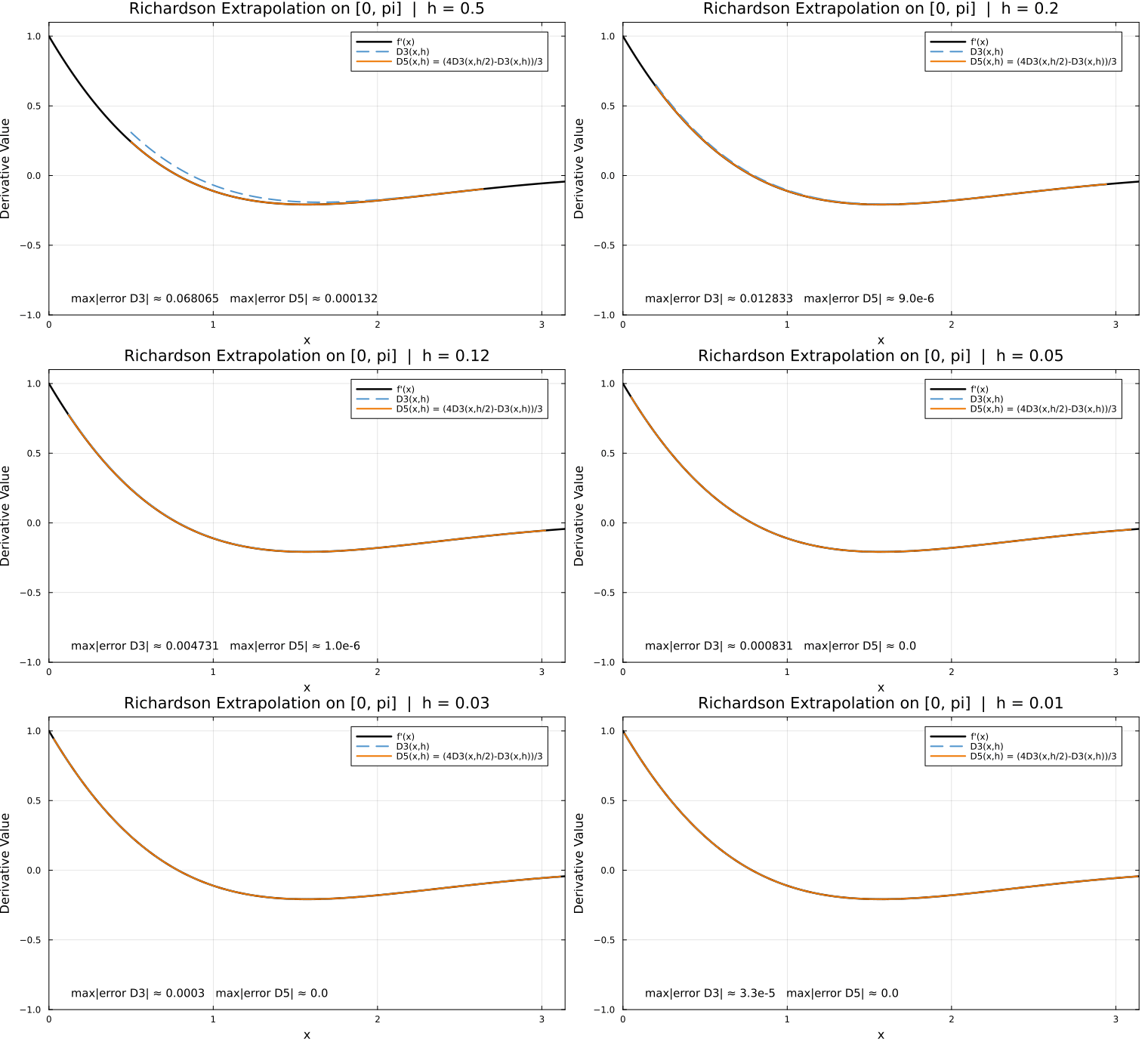
Case 1 - profile comparison, \(D_3(x,h)\) vs. \(D_5(x,h)\)
Behavior: Both approximations converge as \(h\) shrinks, but the Richardson curve tracks \(f'(x)\) much more closely because the dominant \(h^2\) error term is canceled.
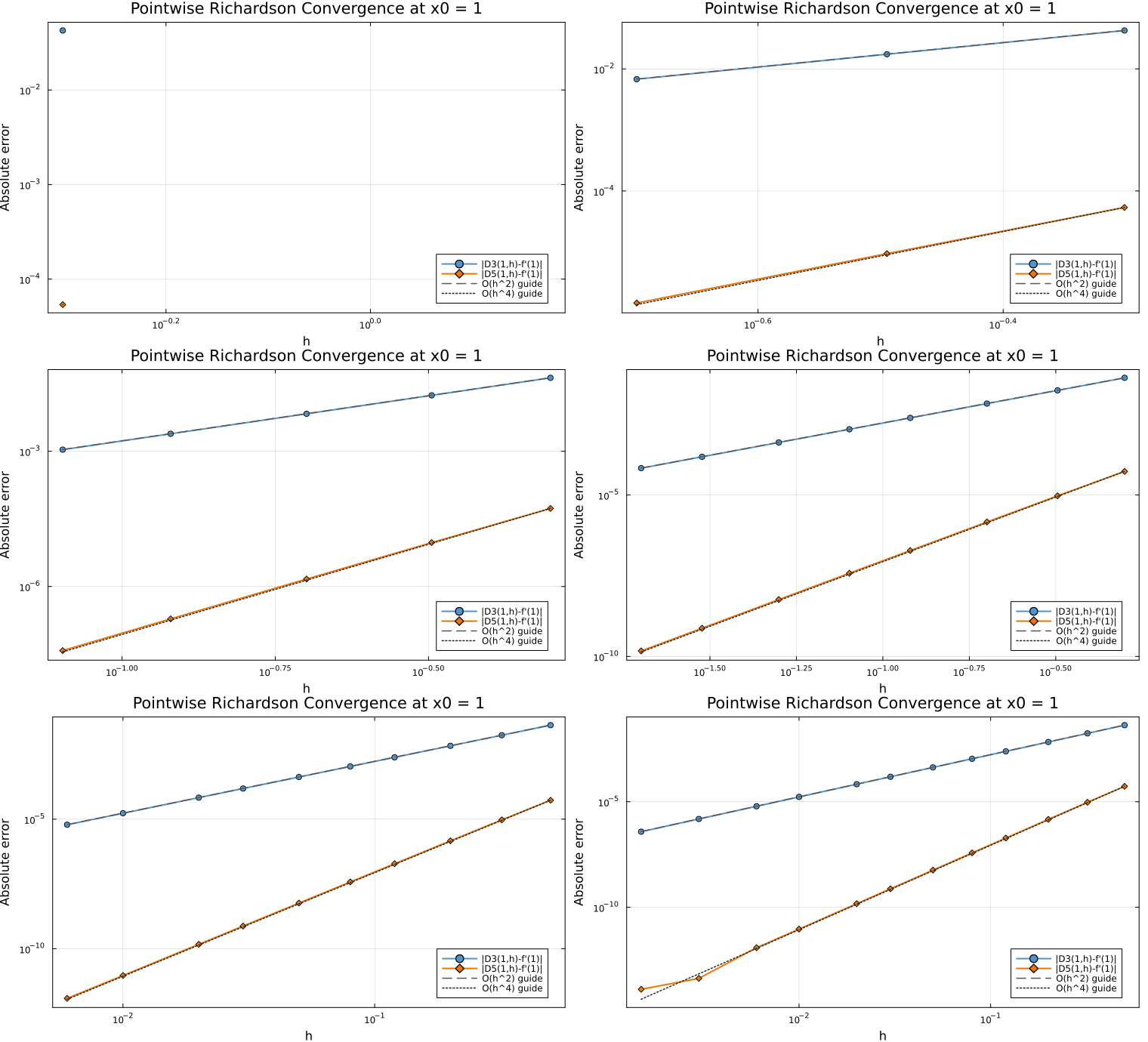
Case 2 - pointwise convergence at \(x_0=1\) on log-log axes
Behavior: The error slope for the three-point formula follows approximately \(O(h^2)\), while Richardson extrapolation follows approximately \(O(h^4)\) before roundoff effects appear.
Derivation Notes
If \(D_3(x,h)=f'(x)+C_2 h^2 + C_4 h^4 + \cdots\), then
\[ \frac{4D_3(x,h/2)-D_3(x,h)}{3} = f'(x) + O(h^4), \]
because the \(C_2 h^2\) contribution cancels exactly.