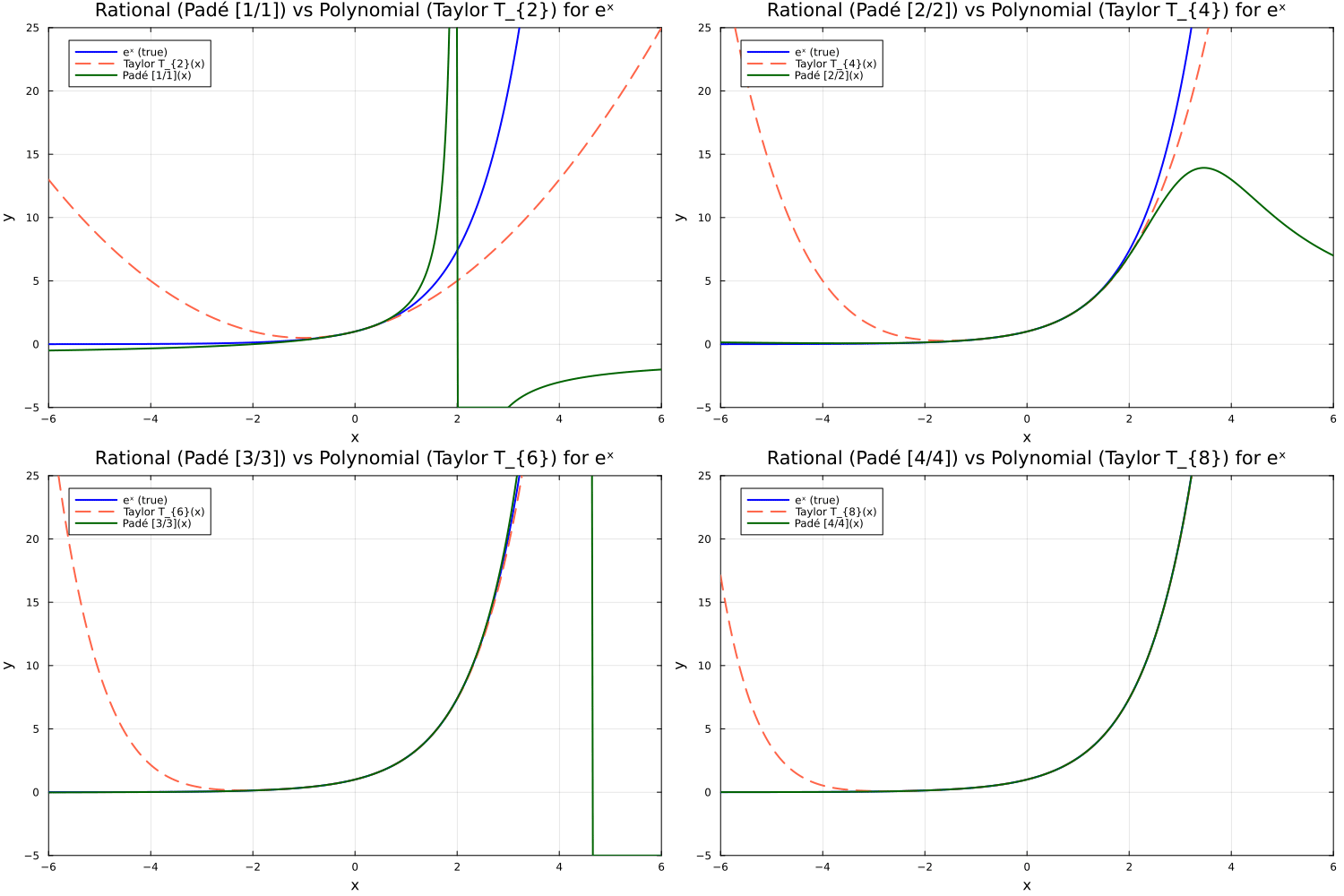
Rational Approximation
Source inspiration: (Mathew 2000-2019).
Description
Rational approximation represents a function by a quotient of polynomials,
\[ R_{m,n}(x)=\frac{P_m(x)}{Q_n(x)},\qquad Q_n(x)\neq 0. \]
Mathews compares three constructions over a fixed interval: interpolation with equally spaced nodes, interpolation with Chebyshev nodes, and a MiniMax (MinMax) construction that spreads error more uniformly. For the MinMax procedure, the goal is to reduce the maximum relative error
\[ \max_{x\in[a,b]}\left|\frac{f(x)-R(x)}{f(x)}\right|. \]
Animations
The animation below follows the Mathews-style workflow for \(f(x)=e^x\) on \([-1,1]\) with a fixed \([2/2]\) rational form: (1) equally spaced nodes, (2) Chebyshev nodes, and (3) a MinMax-style relative-error optimization.
Julia source scripts that generated these animations are linked under each case.
Case 1 — Rational \([2/2]\) for \(e^x\) on \([-1,1]\): equal nodes, Chebyshev nodes, and MinMax
Behavior: Equally spaced interpolation and Chebyshev interpolation are both exact at their nodes, but the maximum relative error over the interval can differ significantly. The MinMax-style step then adjusts coefficients to reduce \(\max |(f-R)/f|\), producing a flatter, more uniform relative-error profile across \([-1,1]\).