Numerical Differentiation
Source inspiration: (Mathew 2000-2019).
Description
Numerical differentiation replaces analytic derivatives with finite-difference quotients built from nearby function values. In the Mathews examples for this module, the test function is \(f(x)=e^{-x}\sin(x)\) on \([0,\pi]\) with representative steps \(h=0.1,0.01,0.001\).
The three-point central approximation for the first derivative is
\[ f'(x) \approx D_3(x,h) = \frac{f(x+h)-f(x-h)}{2h}, \]
with truncation error \(O(h^2)\) when \(f\) is sufficiently smooth. As \(h\) decreases, truncation error improves, but eventually roundoff and cancellation can limit accuracy.
Animations
Each animation below shows finite-difference derivative behavior for \(f(x)=e^{-x}\sin(x)\) on legacy interval settings from the source module.
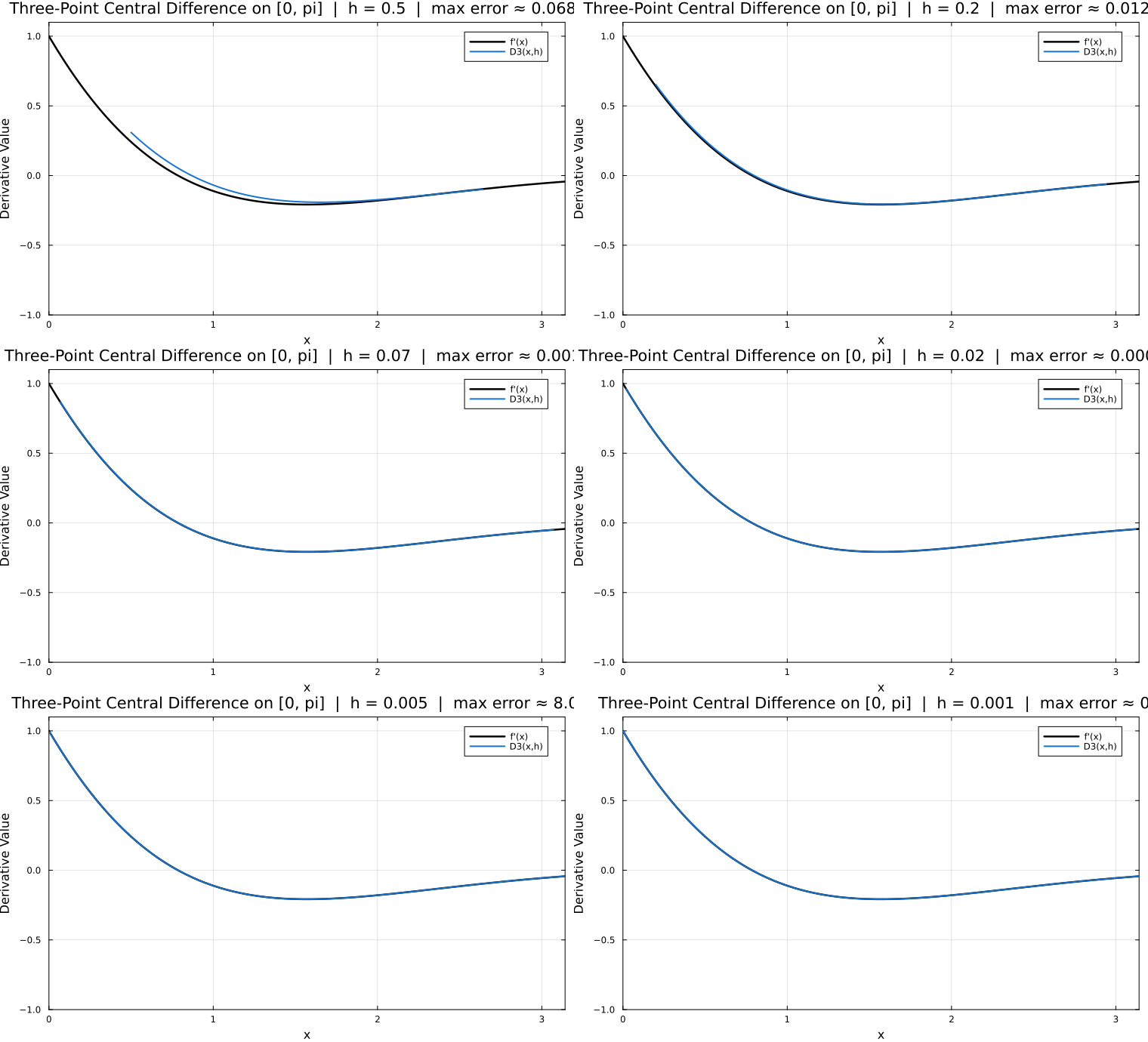
Case 1 - central derivative profile, \(D_3(x,h)\) on \([0,\pi]\)
Behavior: The numerical derivative curve approaches \(f'(x)\) as \(h\) shrinks, consistent with second-order truncation error for the central stencil.
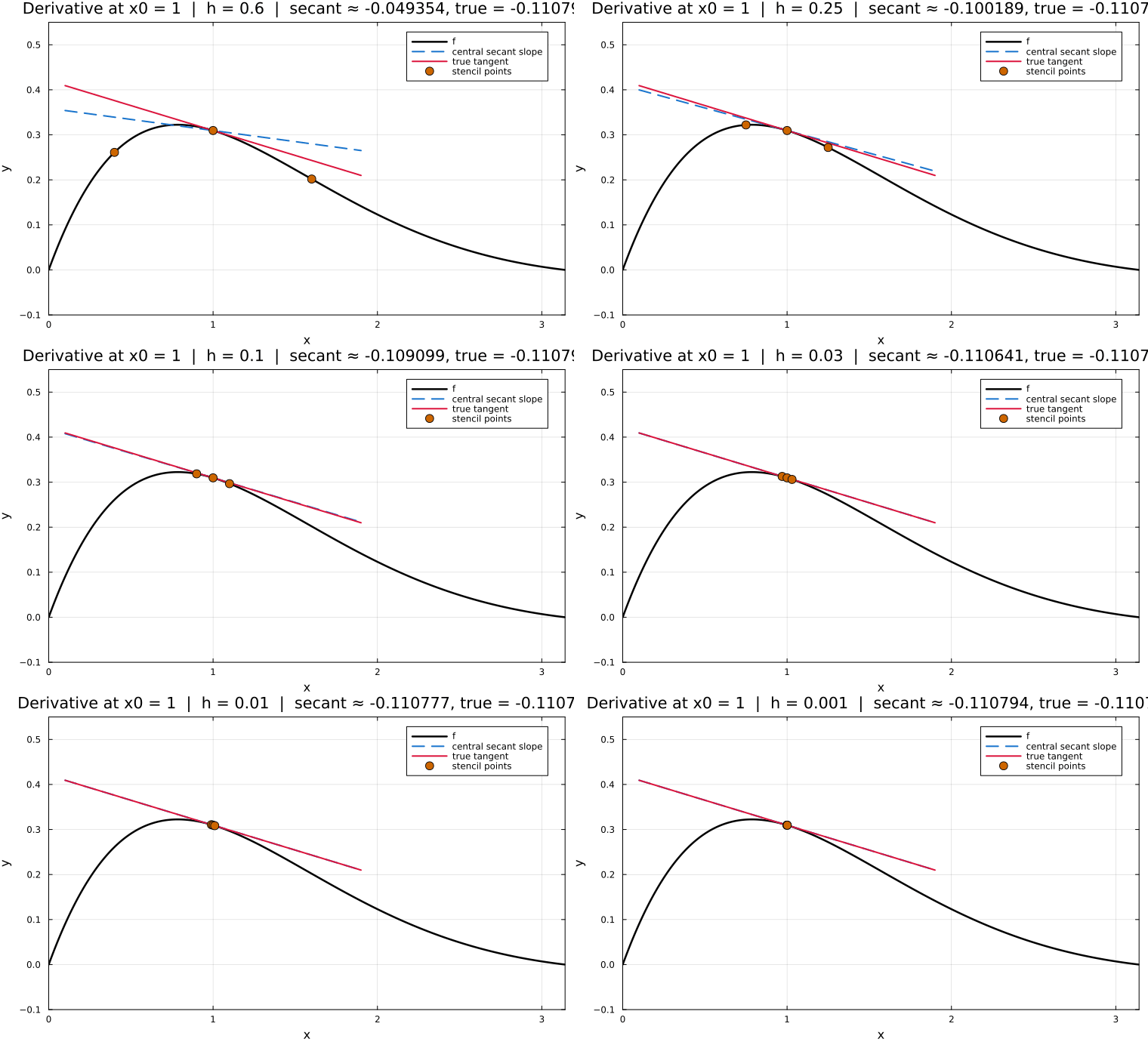
Case 2 - secant to tangent at \(x_0=1\), \(h \to 0\)
Behavior: The slope from the symmetric secant \((f(x_0+h)-f(x_0-h))/(2h)\) converges to the tangent slope \(f'(x_0)\) as the stencil contracts.
Derivation Notes
For smooth \(f\), Taylor expansions about \(x\) give
\[ f(x\pm h) = f(x) \pm h f'(x) + \frac{h^2}{2}f''(x) \pm \frac{h^3}{6}f^{(3)}(\xi_\pm), \]
which leads to the central three-point first-derivative rule with error proportional to \(h^2\).