Nonlinear Systems
Source inspiration: (Mathew 2000-2019).
Description
Many real-world problems require finding a point \((x, y)\) (or a vector \(\mathbf{X}\) in higher dimensions) that simultaneously satisfies several nonlinear equations. The general problem is to solve the nonlinear system
\[\begin{cases} f(x, y) = 0 \\ g(x, y) = 0 \end{cases}\]
Geometrically, each equation defines a curve in the plane and the solutions are the points of intersection of those curves. Two standard iterative strategies extend the scalar root-finding ideas to systems: fixed-point iteration and Newton’s method.
The Jacobian Matrix
Both methods rely on the Jacobian matrix, which collects all first-order partial derivatives and describes how small changes in the inputs propagate to changes in the outputs. For a vector function \(\mathbf{F}(x,y) = \bigl(f(x,y),\; g(x,y)\bigr)^T\) the Jacobian is
\[J(\mathbf{X}) = \begin{pmatrix} \dfrac{\partial f}{\partial x} & \dfrac{\partial f}{\partial y} \\[8pt] \dfrac{\partial g}{\partial x} & \dfrac{\partial g}{\partial y} \end{pmatrix}.\]
In \(n\) dimensions the Jacobian is the \(n \times n\) matrix \(J_{ij} = \partial F_i / \partial x_j\).
Fixed-Point Iteration for Systems
Rewrite the system in the form \(\mathbf{X} = \mathbf{G}(\mathbf{X})\), i.e.
\[\begin{cases} x = g_1(x, y) \\ y = g_2(x, y) \end{cases}\]
and iterate \(\mathbf{X}^{(k+1)} = \mathbf{G}\!\left(\mathbf{X}^{(k)}\right)\) starting from an initial guess \(\mathbf{X}^{(0)}\).
Convergence condition (2D). If the fixed point \(\mathbf{X}^*\) exists and the starting point is sufficiently close to it, the iteration converges provided the row-sum condition holds at \(\mathbf{X}^*\):
\[\left|\frac{\partial g_1}{\partial x}\right| + \left|\frac{\partial g_1}{\partial y}\right| < 1 \qquad \text{and} \qquad \left|\frac{\partial g_2}{\partial x}\right| + \left|\frac{\partial g_2}{\partial y}\right| < 1.\]
When these inequalities are violated the iteration typically diverges, regardless of how close the starting point is.
Newton’s Method for Nonlinear Systems
Newton’s method extends the scalar tangent-line idea by using the Jacobian to linearize \(\mathbf{F}\) at the current iterate. Near a point \(\mathbf{X}^{(k)}\) we approximate
\[\mathbf{F}\!\left(\mathbf{X}^{(k)} + \Delta\mathbf{X}\right) \approx \mathbf{F}\!\left(\mathbf{X}^{(k)}\right) + J\!\left(\mathbf{X}^{(k)}\right)\,\Delta\mathbf{X} = \mathbf{0}.\]
This linear system is solved for the Newton step \(\Delta\mathbf{X}\) and the iterate is updated:
\[J\!\left(\mathbf{X}^{(k)}\right)\,\Delta\mathbf{X}^{(k)} = -\mathbf{F}\!\left(\mathbf{X}^{(k)}\right), \qquad \mathbf{X}^{(k+1)} = \mathbf{X}^{(k)} + \Delta\mathbf{X}^{(k)}.\]
The four steps of one Newton iteration are:
- Evaluate \(\mathbf{F}\!\left(\mathbf{X}^{(k)}\right)\).
- Evaluate the Jacobian \(J\!\left(\mathbf{X}^{(k)}\right)\).
- Solve the linear system \(J\,\Delta\mathbf{X} = -\mathbf{F}\) for \(\Delta\mathbf{X}\).
- Set \(\mathbf{X}^{(k+1)} = \mathbf{X}^{(k)} + \Delta\mathbf{X}\).
Newton’s method converges quadratically near a non-singular solution (one where \(\det J(\mathbf{X}^*) \neq 0\)), meaning the number of correct digits roughly doubles each iteration. If the Jacobian is singular at the solution, the quadratic rate is lost. Because the formulation is dimension-independent, exactly the same algorithm applies in 3D, 10D, or any higher dimension — only the size of the linear system in Step 3 changes.
Comparison
| Property | Fixed-Point Iteration | Newton’s Method |
|---|---|---|
| Convergence rate | Linear (when it converges) | Quadratic |
| Cost per iteration | Low (function evaluations only) | Higher (Jacobian + linear solve) |
| Convergence guarantee | Requires row-sum condition | Requires good starting guess |
| Starting-point sensitivity | High | Moderate |
Newton’s method is generally preferred when high accuracy is needed and the Jacobian is cheap to form. Fixed-point iteration is simpler to implement but requires careful formulation of \(\mathbf{G}\) to satisfy the convergence condition.
Animations
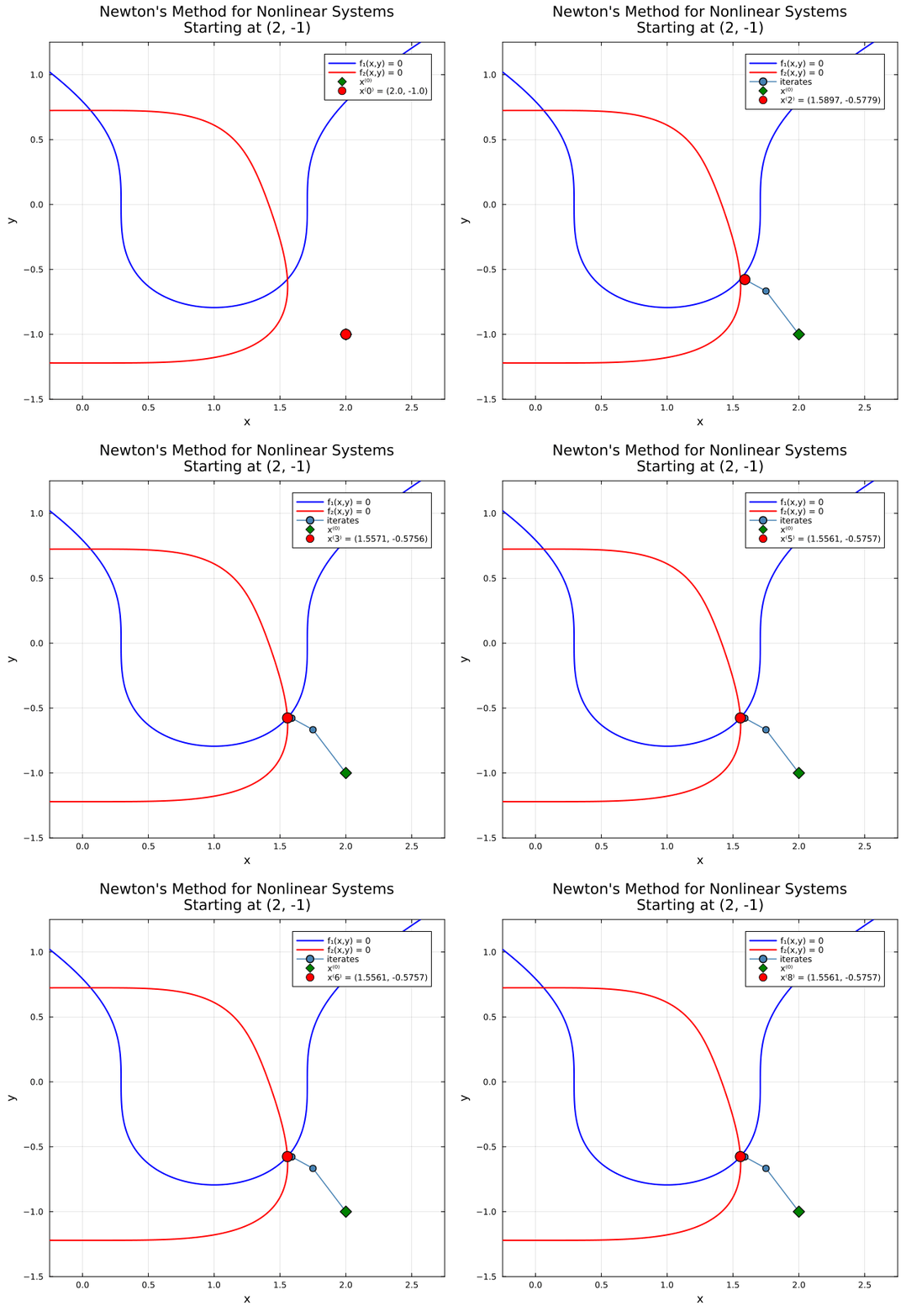
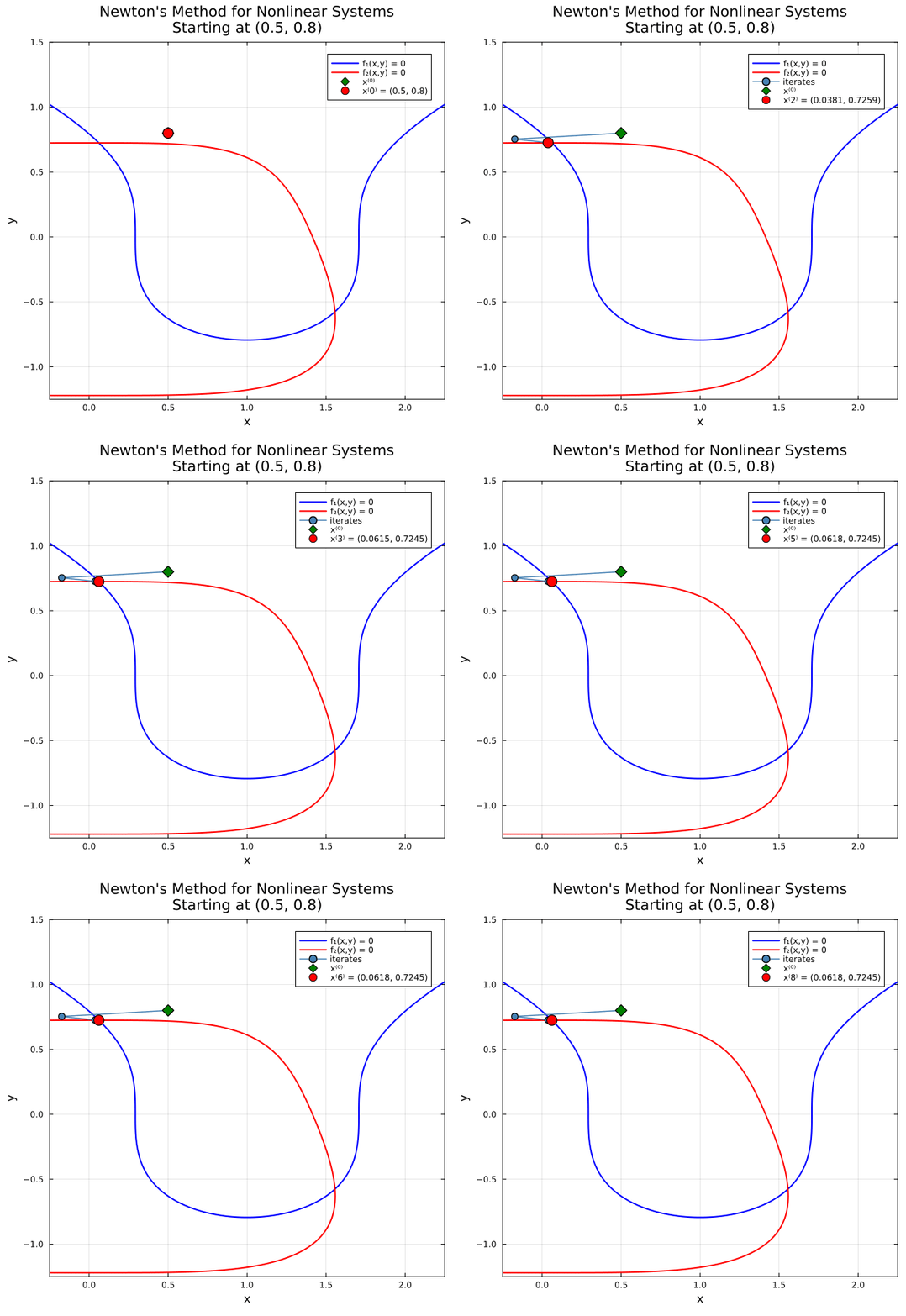
Each animation below shows the Newton iteration path in the \(xy\)-plane for the system
\[\begin{cases} f_1(x,y) = 1 - 4x + 2x^2 - 2y^3 = 0 \\ f_2(x,y) = -4 + x^4 + 4y + 4y^4 = 0 \end{cases}\]
The blue curve is \(f_1 = 0\) and the red curve is \(f_2 = 0\). Their two intersections are the solutions. Each frame adds one Newton step: the Jacobian is evaluated at the current point, the linear system \(J\,\Delta\mathbf{X} = -\mathbf{F}\) is solved, and the iterate moves to \(\mathbf{X}^{(k+1)} = \mathbf{X}^{(k)} + \Delta\mathbf{X}^{(k)}\). Quadratic convergence means the error roughly squares each step — the path reaches the intersection within a handful of iterations from anywhere in the basin.
Julia source scripts that generated these animations are linked under each case.
Case 1 — Solution 1, starting at \((0.5,\; 0.8)\)
Behavior: Starting in the upper region between the two curves, Newton’s method converges rapidly to Solution 1 at approximately \((x^*, y^*) \approx (0.0618,\; 0.7245)\), the intersection in the upper-left portion of the plot. The path reaches machine precision in a few steps, demonstrating \(|g'(x^*)| \approx 0\) — quadratic convergence in 2D.
Case 2 — Solution 2, starting at \((2,\; -1)\)
Behavior: Starting in the lower-right region near Solution 2, Newton’s method converges to \((x^*, y^*) \approx (1.5561,\; -0.5757)\), the intersection near the bottom of the curves. This solution has a large negative \(y\) component and lies at the outer loop of the \(f_2 = 0\) curve. Again convergence is quadratic: the first step brings the iterate close to the solution, and subsequent steps nail it to full precision.