Muller’s Method
Source inspiration: (Mathew 2000-2019).
Animations
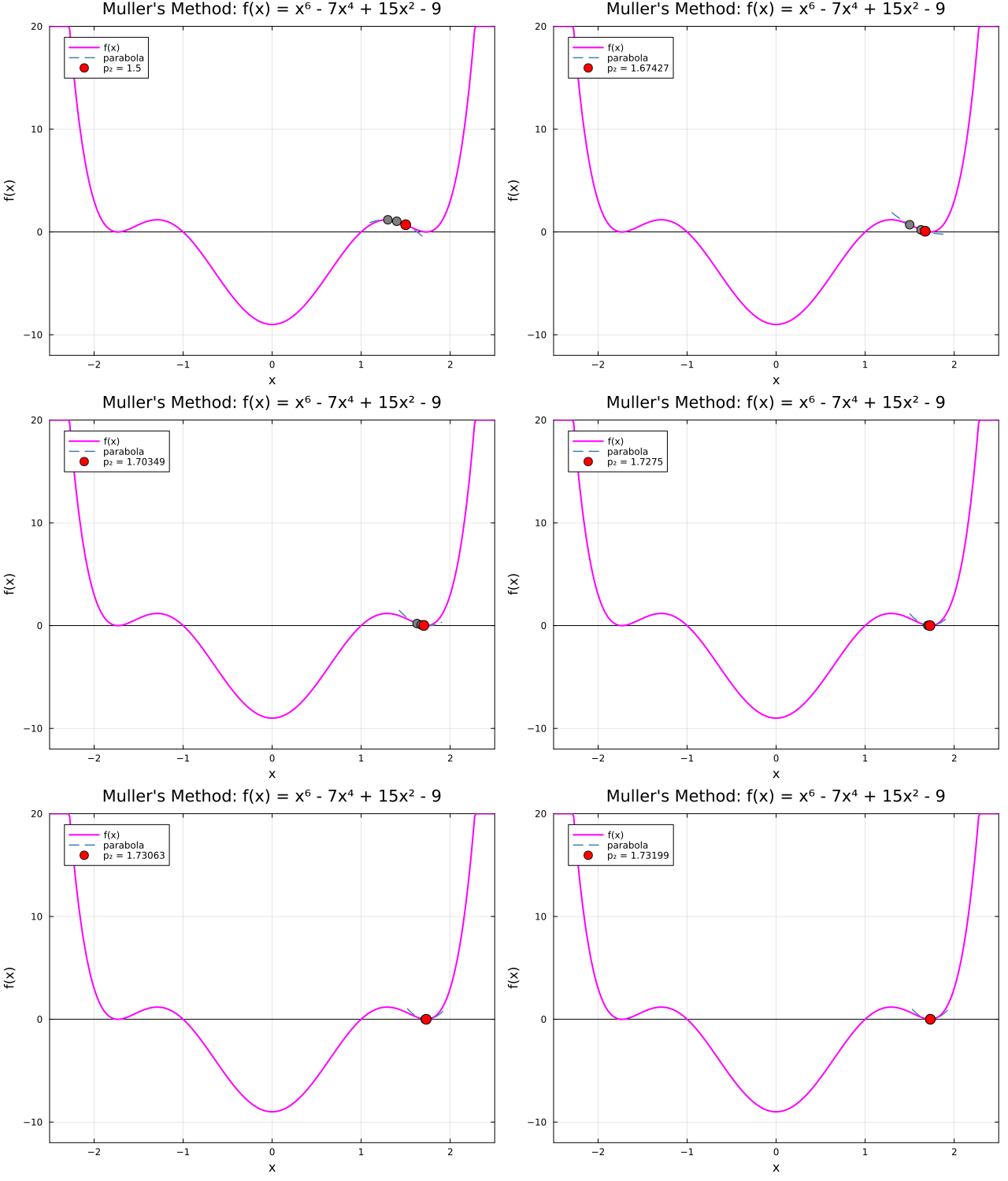
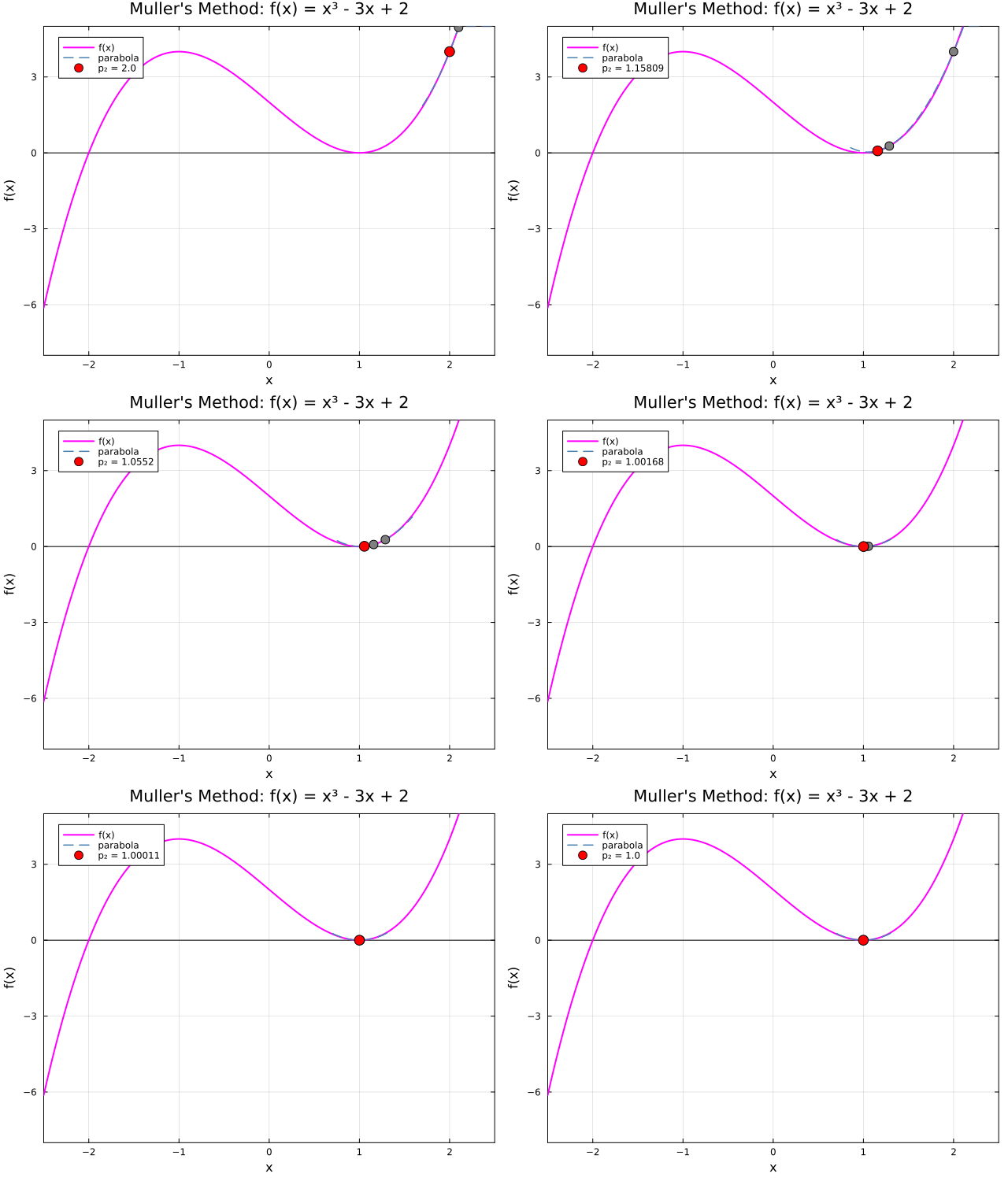
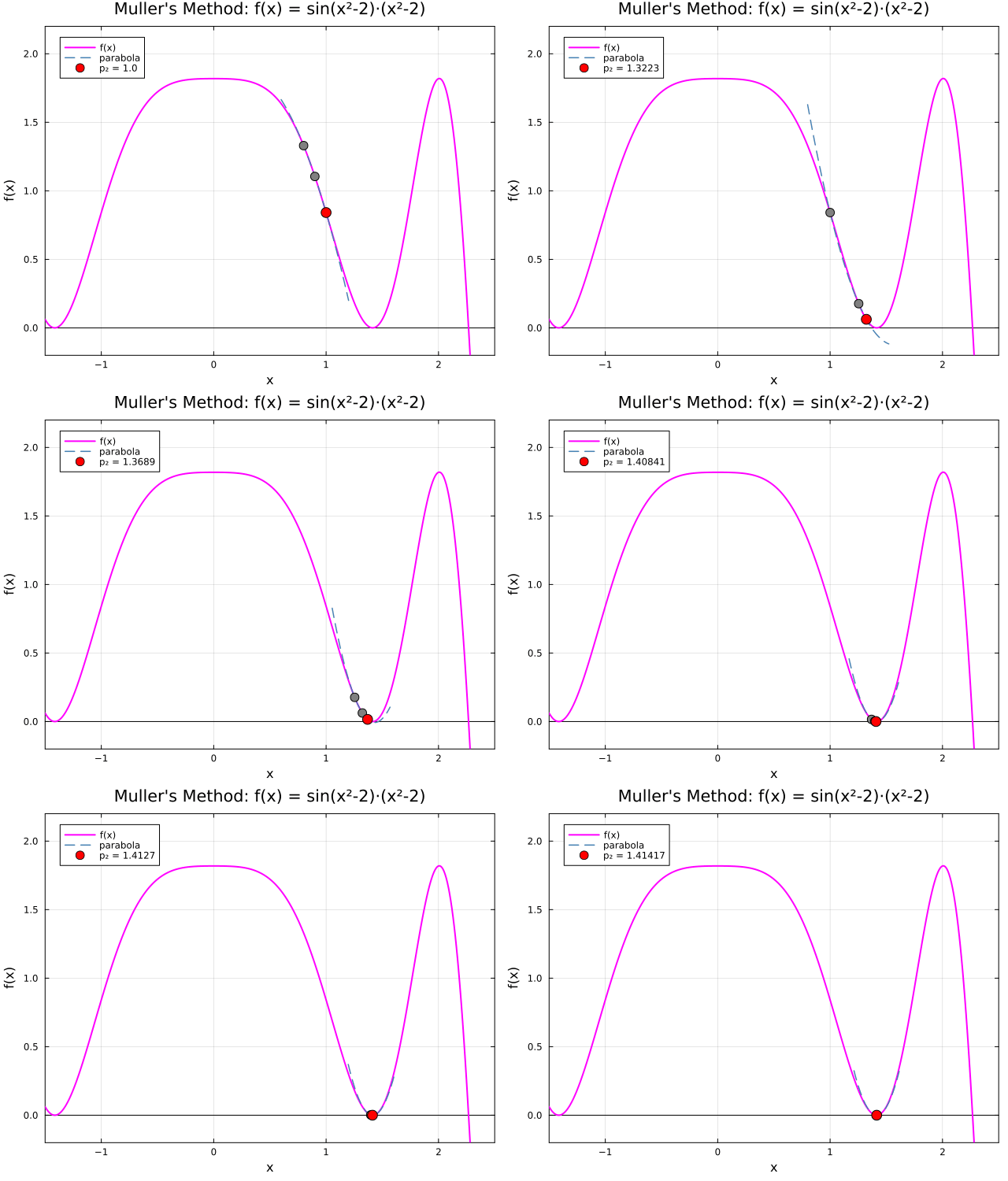
Each animation below shows Muller’s Method fitting a parabola through three successive approximations of a root. The parabola (dashed blue) passes through the current triple \((p_0, p_1, p_2)\), and the next iterate is found where the parabola crosses the x-axis. Each frame advances one iteration: the oldest point is dropped, and the new root estimate becomes \(p_2\) (red dot). The gray dots are \(p_0\) and \(p_1\).
Julia source scripts that generated these animations are linked under each case.
Case 1 — Convergent, \(f(x) = x^3 - 3x + 2\), double root at \(p = 1\)
Behavior: The method converges to the double root \(p = 1\) of \(f(x) = (x-1)^2(x+2)\). Starting near \(p_2 = 2.0\), the iterates approach \(p = 1\) with order \(\approx 1.84\) convergence — faster than Newton’s method, which has only linear convergence on double roots.
Case 2 — Convergent, \(f(x) = \sin(x^2 - 2)(x^2 - 2)\), double root at \(p = \sqrt{2}\)
Behavior: The method converges to the double root \(p = \sqrt{2} \approx 1.4142\) starting from \(p_2 = 1.0\). The function has a double root where \(x^2 - 2 = 0\) since both factors vanish simultaneously, and Muller’s method locates it efficiently despite the flat tangent at the root.
Case 3 — Convergent, \(f(x) = x^6 - 7x^4 + 15x^2 - 9\), double root near \(x = 2\)
Behavior: The function factors as \((x^2-1)(x^2-3)^2\), giving a double root at \(p = \sqrt{3} \approx 1.7321\). Starting from \(p_2 = 1.5\), Muller’s method converges to the double root. Newton’s method would converge linearly here; Muller’s method converges superlinearly with order \(\approx 1.84\).