Damped Newton with Acceleration (Madsen-Reid Method)
Description
The Madsen-Reid method (Madsen and Reid 1975) is a robust, globally convergent Newton-based algorithm for finding all roots of a real-coefficient polynomial. It combines three complementary ideas into a single, practical solver:
1. Quadratic convergence — even at multiple roots
Standard Newton-Raphson degrades to linear convergence at a root of multiplicity \(m > 1\) because \(f'(x^*) = 0\), which inflates each step. Madsen-Reid avoids this by taking multiple steps in the same direction — the step-size limit \(r_0\) is increased fivefold after each accepted step:
\[r_0 \leftarrow 5\,|\Delta z|\]
This acceleration allows the iterates to accelerate toward the root rather than stalling, recovering quadratic-like convergence in practice even when \(f'(x^*)\) is small.
2. Safety — the dual-stage strategy
The algorithm alternates between two stages based on whether the current Newton step reduces \(|f|^2\):
- Stage 2 (Newton): If the full Newton step \(\Delta z = f(z)/f'(z)\) reduces \(|f(z)|^2\), it is accepted as-is. This is the fast, quadratic phase.
- Stage 1 (Damped): If the full Newton step increases \(|f(z)|^2\), the step is repeatedly halved (up to 4 times) until a reducing step is found. If halving fails,
alterdirectionrotates the step by approximately \(53°\) and scales it, breaking symmetry and escaping saddle points or cycles.
The dual-stage structure guarantees that \(|f(z)|^2\) is a monotonically non-increasing Lyapunov function along the iteration, giving the algorithm its global convergence character without requiring a full line search.
3. Efficiency — minimizing function evaluations
Higher-order methods (Halley’s, Householder’s) achieve cubic or higher convergence but require evaluating \(f''\), \(f'''\), etc. Madsen-Reid achieves rapid convergence using only \(f\) and \(f'\) — the same cost as plain Newton — while the acceleration mechanism and dual-stage control make it far more reliable than unguarded Newton on difficult polynomials.
After each root is found, the polynomial is deflated (divided out), reducing the degree by 1 (real root) or 2 (complex conjugate pair), until the remaining linear or quadratic factor is solved analytically.
Note on generalization: The core ideas — dual-stage damped stepping, acceleration by relaxing the step-size limit, and direction alteration near saddle points — are not limited to polynomials. The same framework can be applied to general nonlinear equations \(f(x) = 0\) or systems \(\mathbf{F}(\mathbf{x}) = \mathbf{0}\), where it provides a reliable alternative to trust-region methods. For polynomial root-finding specifically, the Horner-based \(|f|^2\) evaluation is particularly cheap, but the algorithmic structure translates directly to general scalar and vector problems.
Animations
Each animation shows the iteration path of the Madsen-Reid method. Blue segments indicate accepted Newton steps (Stage 2); orange segments indicate damped or direction-altered steps (Stage 1). The star markers show the exact root(s).
Julia source scripts that generated these animations are linked under each case.
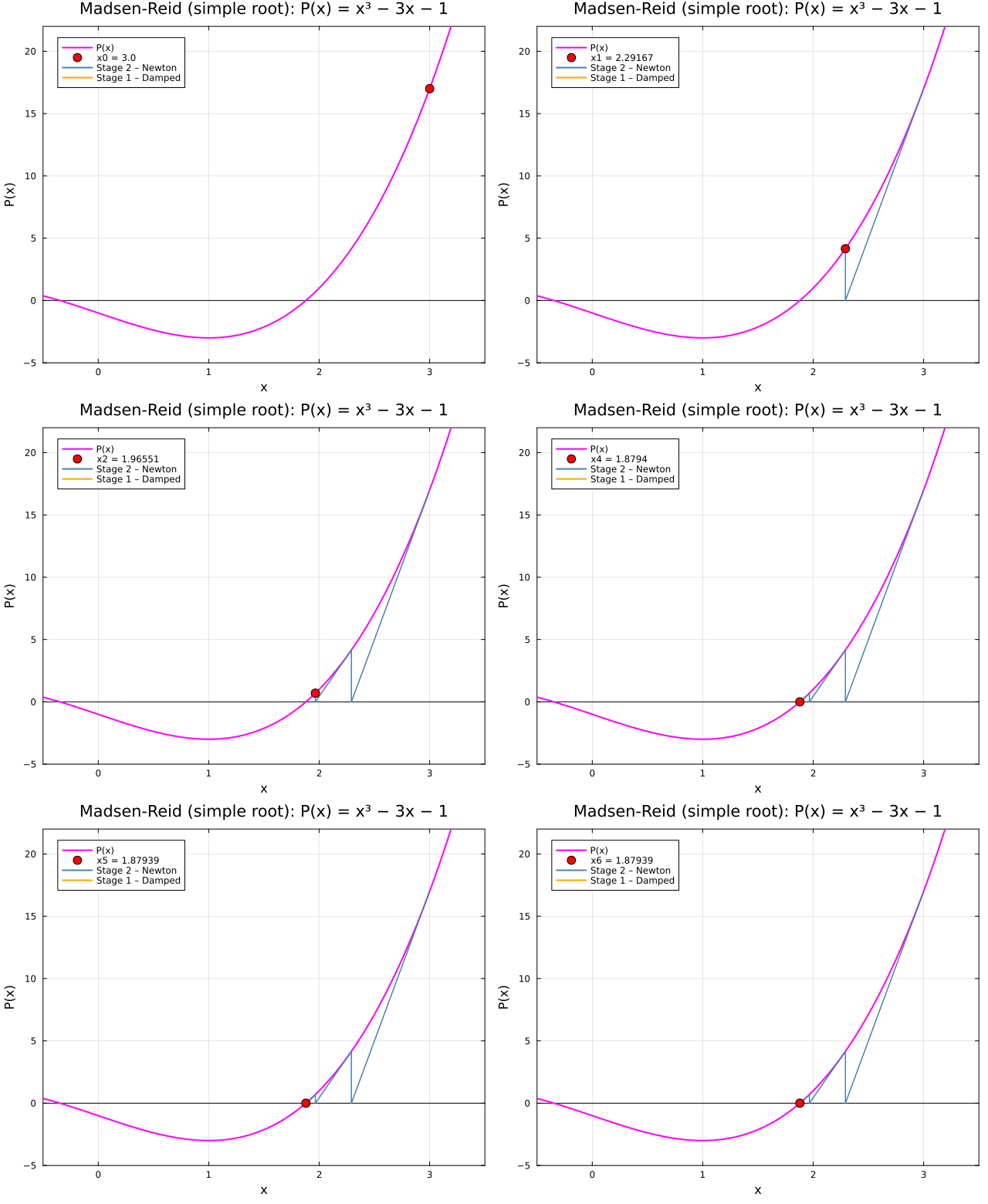
Case 1 — Simple root, \(P(x) = x^3 - 3x - 1\), \(x_0 = 3.0\)
Behavior: Three simple real roots exist. Starting from \(x_0 = 3.0\), the algorithm begins with Stage 2 Newton steps and converges rapidly to the root near \(x^* \approx 1.8794\). Because \(|P'(x^*)| \neq 0\), the convergence is quadratically fast with no damping needed after the first couple of frames.
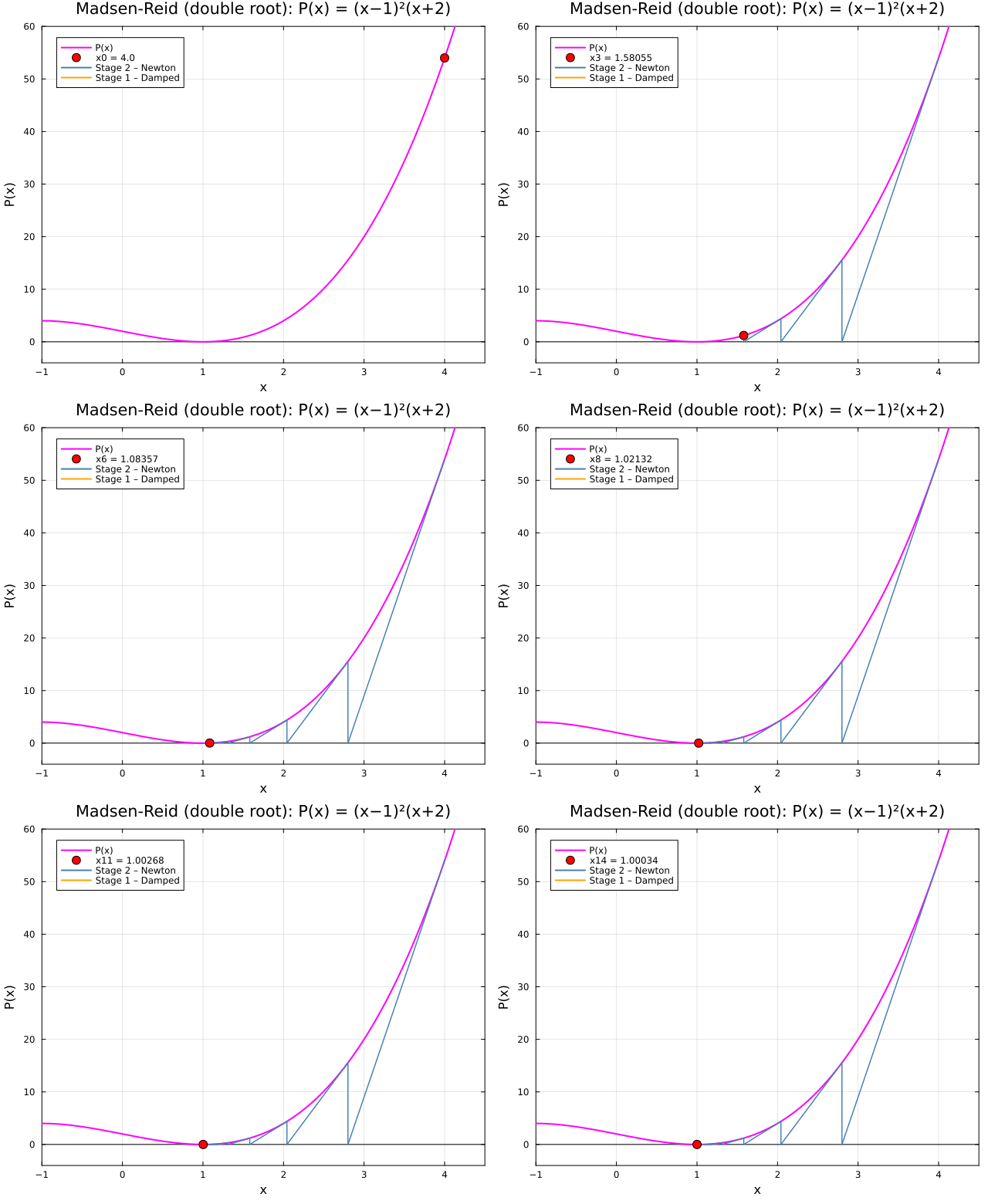
Case 2 — Double root, \(P(x) = (x-1)^2(x+2)\), \(x_0 = 4.0\)
Behavior: \(P(x)\) has a double root at \(x^* = 1\) where \(P'(x^*) = 0\). Standard Newton-Raphson would converge only linearly here. The Madsen-Reid acceleration mechanism — growing \(r_0\) fivefold each step — allows the iterates to accelerate past the stalling zone, recovering faster-than-linear convergence. Orange (Stage 1) frames show where the step is damped to control overshoot; blue (Stage 2) frames show the accelerated Newton phase. The simple root at \(x = -2\) may also be found depending on which root the deflation targets first.
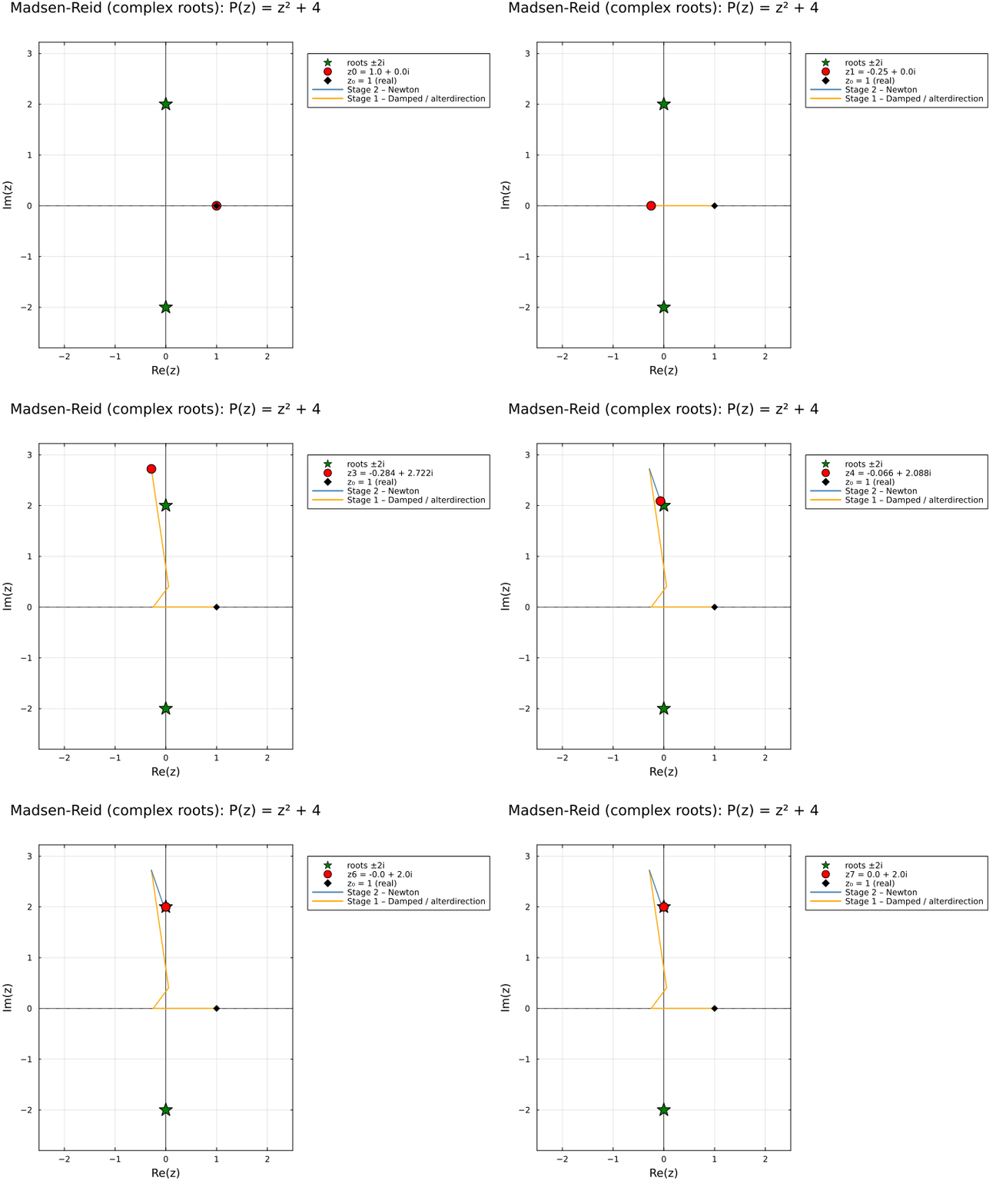
Case 3 — Complex conjugate roots, \(P(z) = z^2 + 4\), \(z_0 = 1 + 0i\)
Behavior: The roots are \(z^* = \pm 2i\) — there are no real roots. Starting on the real axis at \(z_0 = 1\), the real-axis Newton iterates cannot reach a real root and stagnate. The alterdirection mechanism rotates the step into the complex plane, allowing the iterates to escape the real axis. The path traces a curved trajectory in \(\mathbb{C}\) converging to \(z^* = +2i\). Blue segments are Stage 2 Newton steps; orange segments with direction changes are the alterdirection escapes. This case illustrates how the algorithm handles polynomials with no real roots starting from a real initial guess.