Improved Newton Method
Source inspiration: (Mathew 2000-2019).
Animations
Each animation below shows the tangent-line diagram for Newton-type iterations on functions with multiple roots. At each iterate \(x_n\), the line connecting \((x_n, f(x_n))\) to the next iterate’s x-intercept traces the convergence path. Standard Newton-Raphson degrades to linear convergence at multiple roots; Method A (accelerated) restores quadratic convergence by multiplying the Newton step by the root’s multiplicity \(m\).
Julia source scripts that generated these animations are linked under each case.
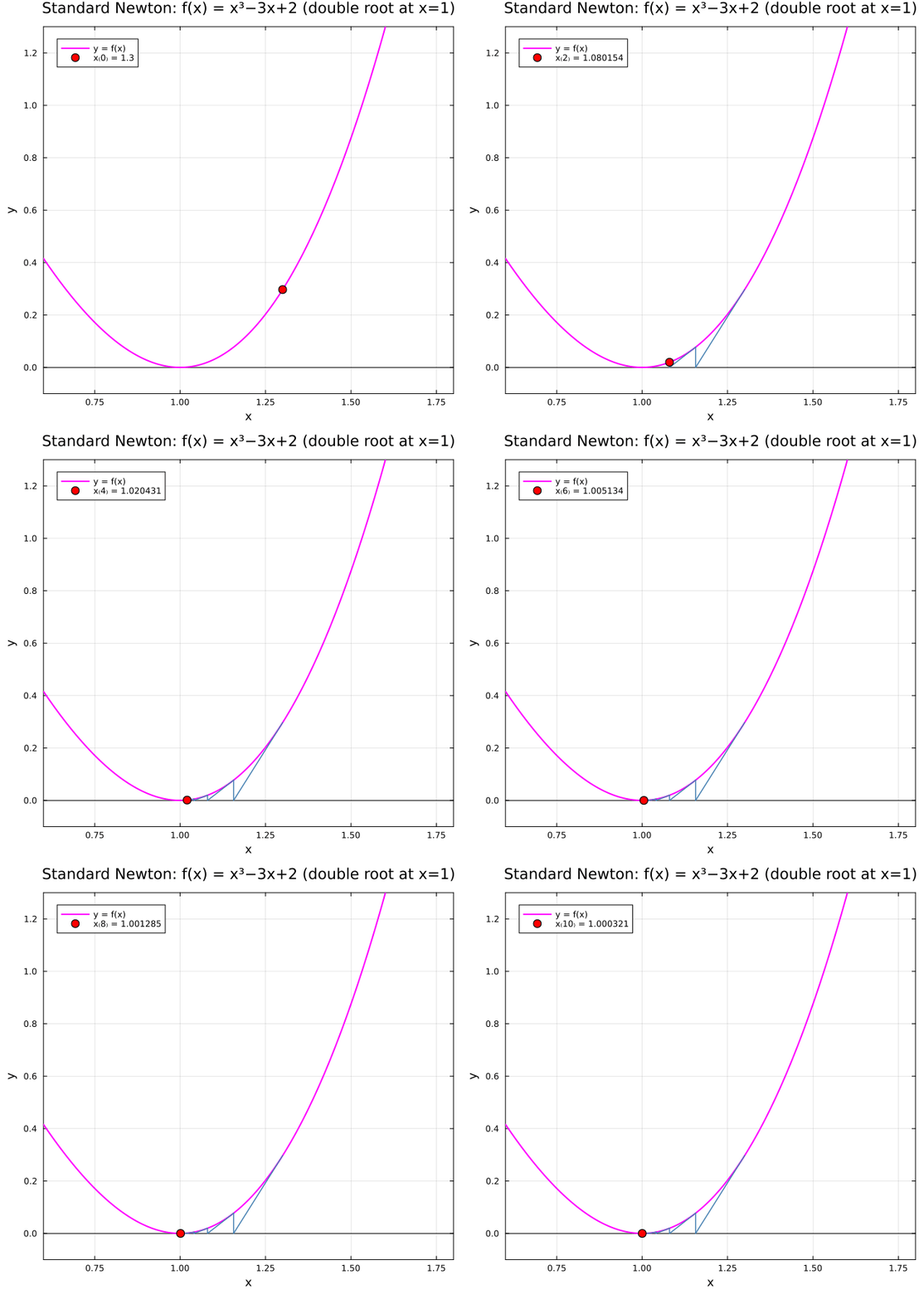
Case 1 — Standard Newton, linear convergence (double root), \(f(x) = x^3 - 3x + 2\), \(x_0 = 1.3\)
Behavior: \(f(x) = x^3 - 3x + 2 = (x-1)^2(x+2)\) has a double root at \(x^* = 1\). Because \(f'(x^*) = 0\) at a multiple root, the standard convergence proof breaks down. Each step only halves the error rather than squaring it — the iteration creeps slowly toward \(x = 1\) over many steps.
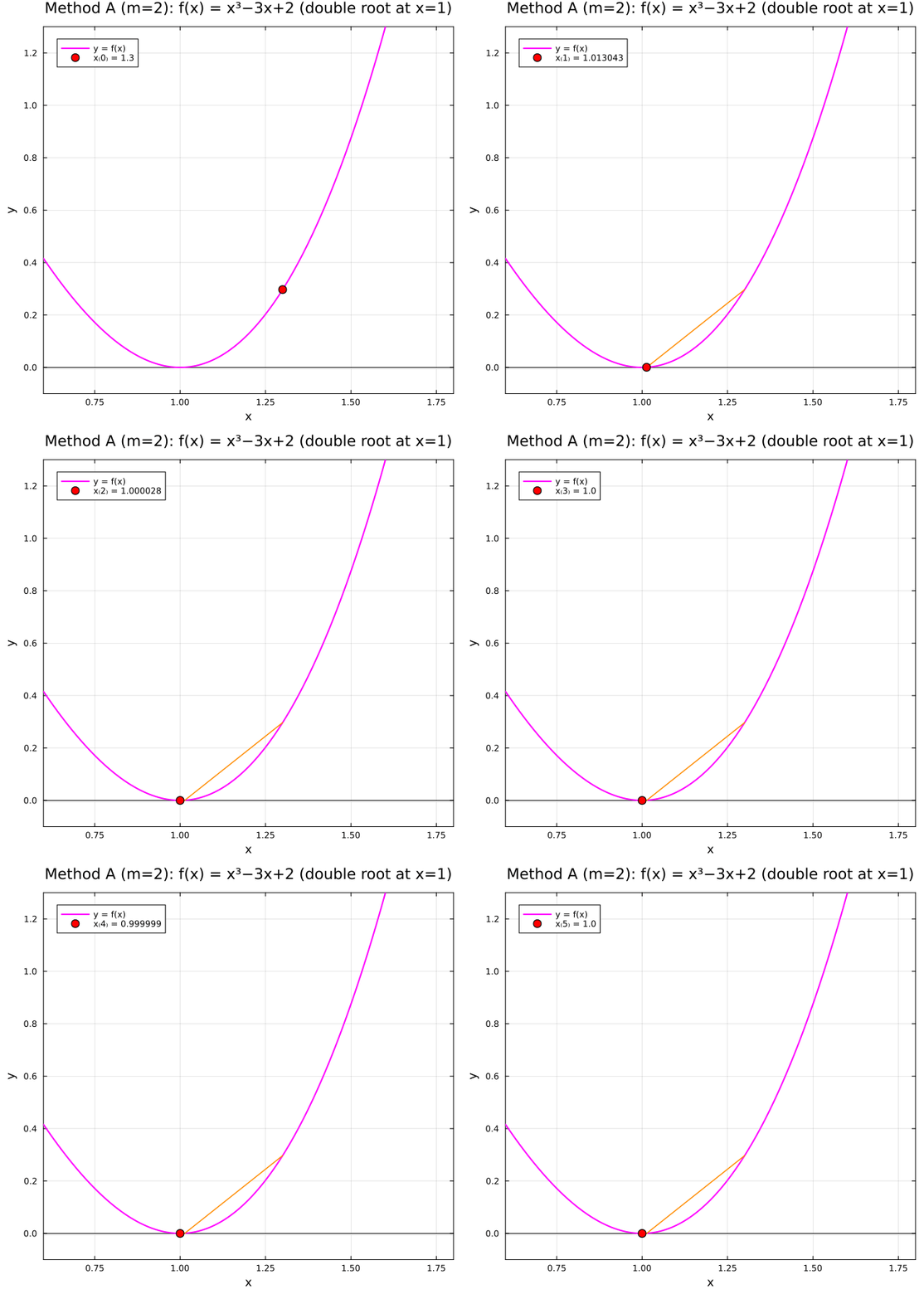
Case 2 — Method A (accelerated, \(m=2\)), quadratic convergence, \(f(x) = x^3 - 3x + 2\), \(x_0 = 1.3\)
Behavior: Method A uses \(x_{n+1} = x_n - m \cdot \tfrac{f(x_n)}{f'(x_n)}\) with \(m = 2\) (the known multiplicity). The enlarged step compensates for the vanishing derivative at the double root, restoring quadratic convergence. Compare the rapid convergence here against the slow Case 1 — same function, same starting point, completely different speed.
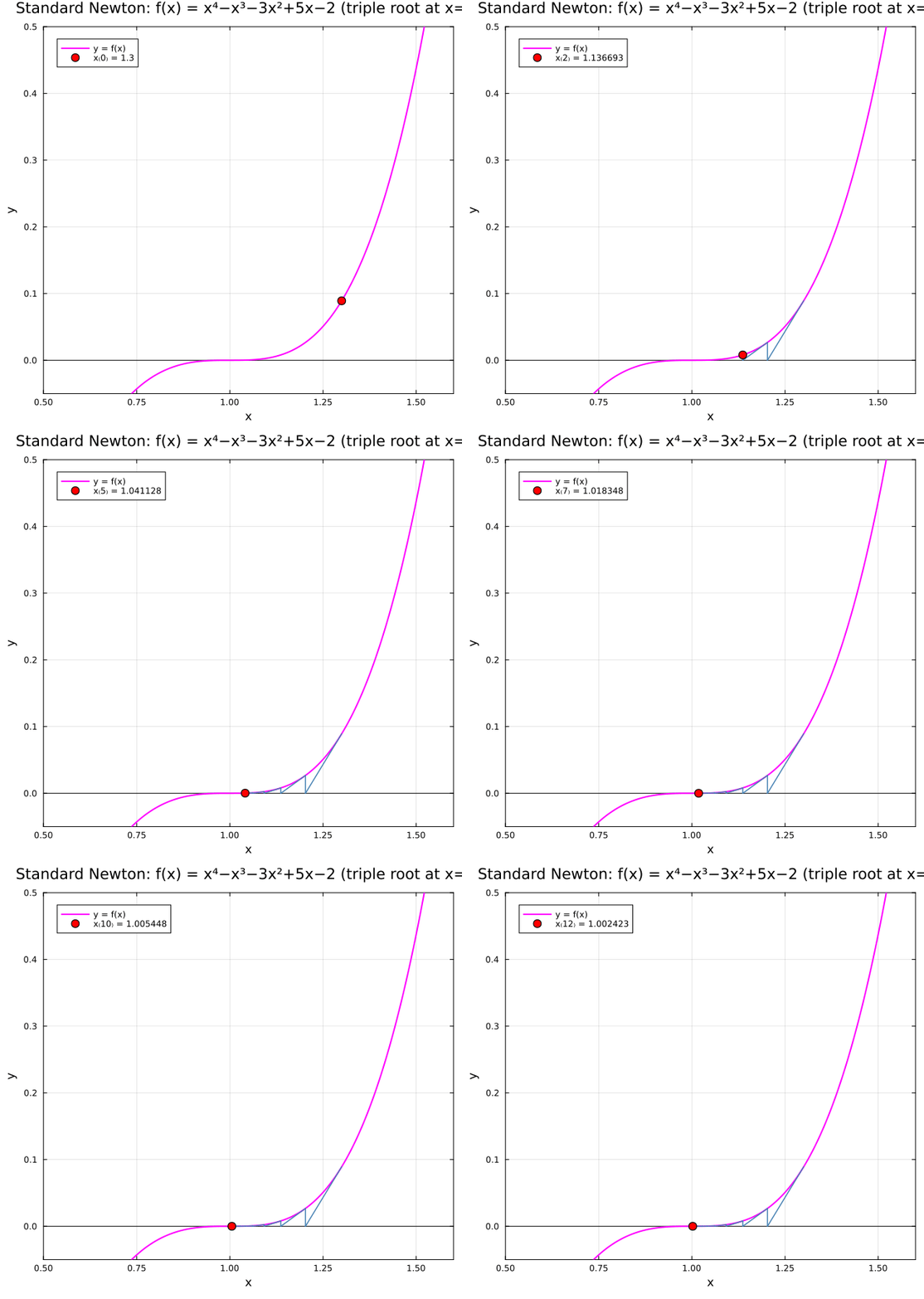
Case 3 — Standard Newton, even slower convergence (triple root), \(f(x) = x^4 - x^3 - 3x^2 + 5x - 2\), \(x_0 = 1.3\)
Behavior: \(f(x) = (x-1)^3(x+2)\) has a triple root at \(x^* = 1\). The asymptotic error constant for standard Newton at an order-\(m\) root is \((m-1)/m\). For a triple root this is \(2/3\), meaning each iterate only reduces the error by \(1/3\) — even slower than the double-root case.
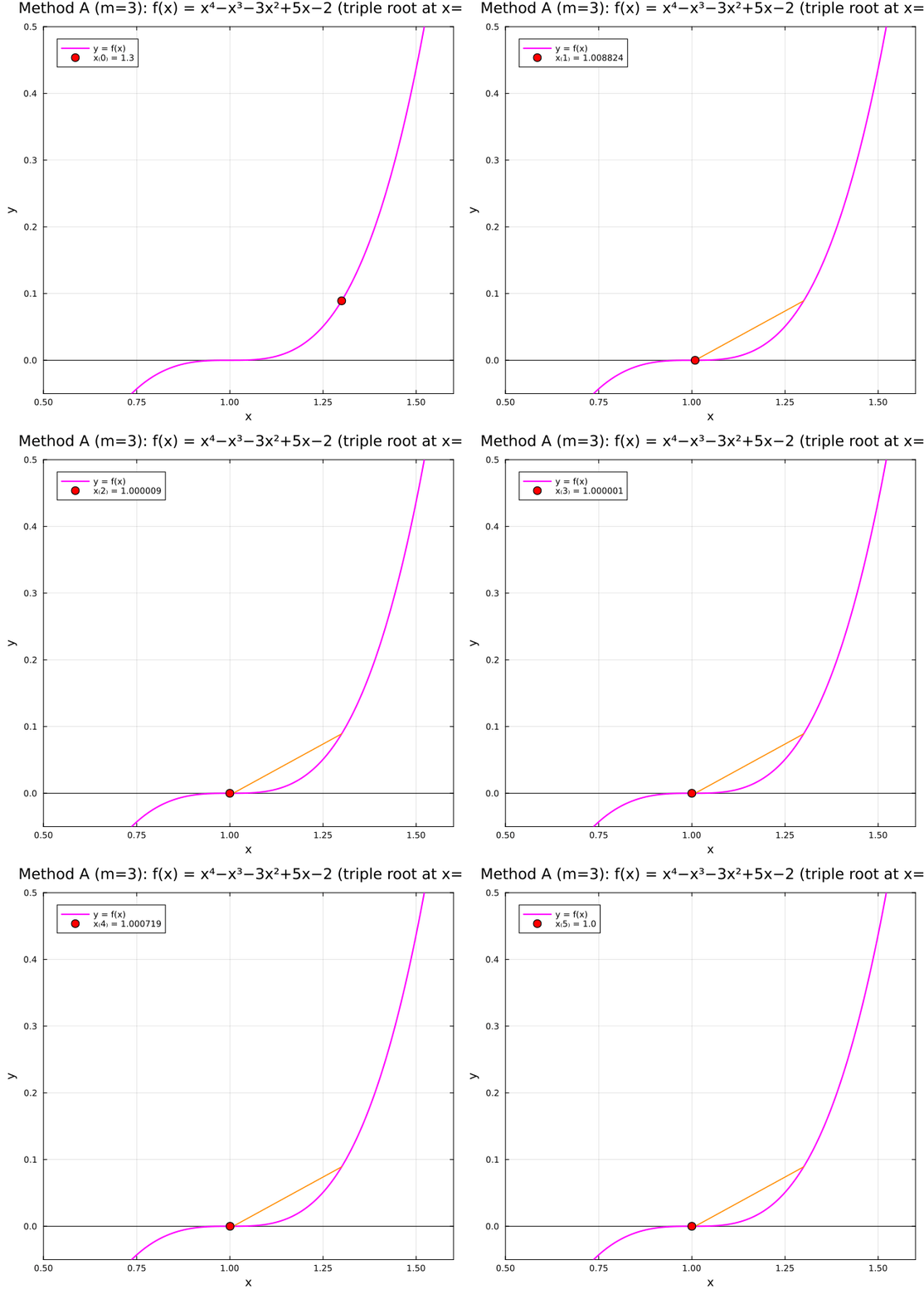
Case 4 — Method A (accelerated, \(m=3\)), quadratic convergence, \(f(x) = x^4 - x^3 - 3x^2 + 5x - 2\), \(x_0 = 1.3\)
Behavior: Method A with \(m = 3\) (the correct multiplicity) restores quadratic convergence at the triple root. The convergence is dramatic compared to Case 3 — the iterate reaches \(x \approx 1\) in just a couple of steps. This illustrates the core advantage of the improved methods: knowing \(m\) unlocks quadratic convergence regardless of root order.
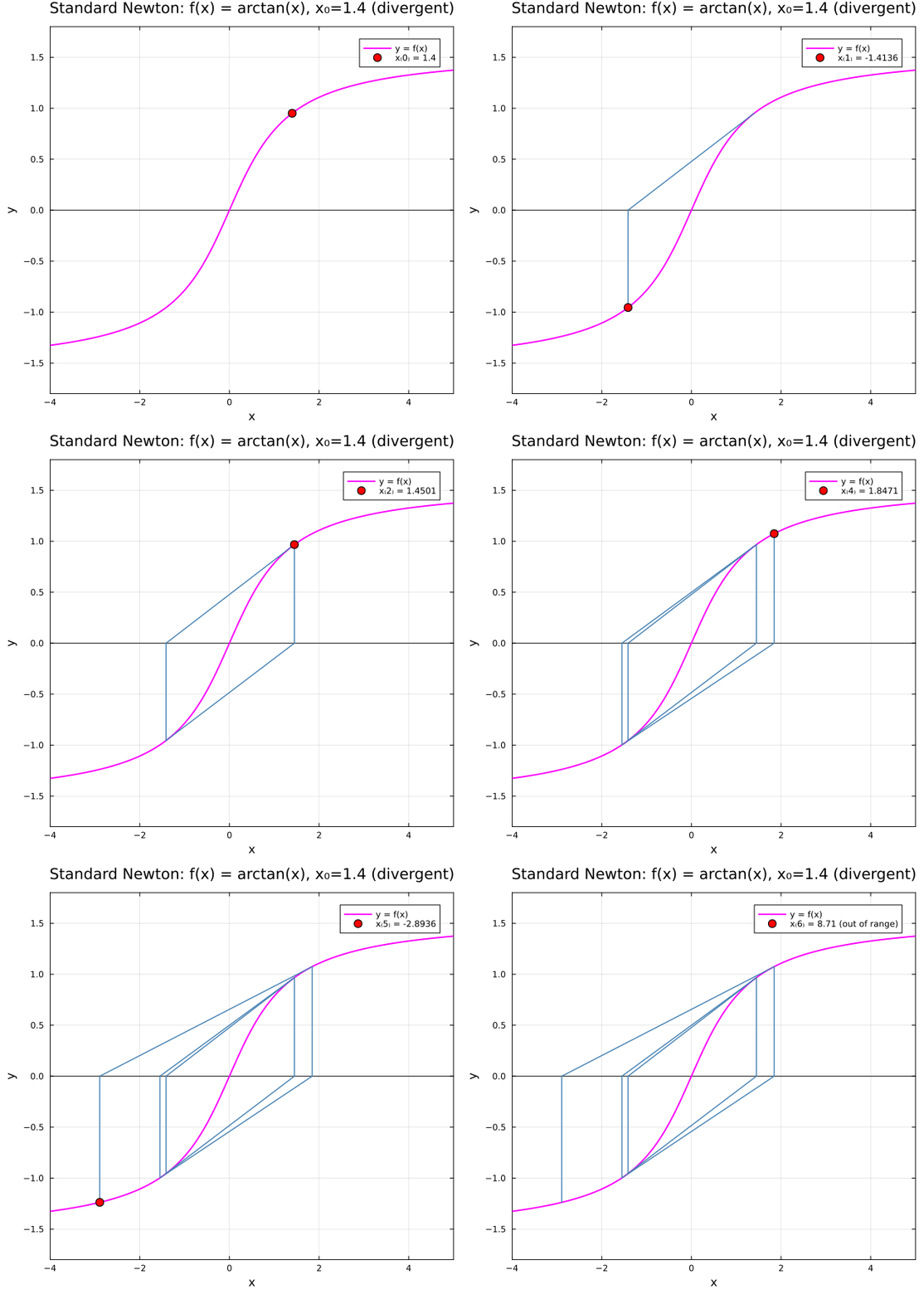
Case 5 — Standard Newton diverges, \(f(x) = \arctan(x)\), \(x_0 = 1.4\)
Behavior: \(f(x) = \arctan(x)\) has a simple root at \(x^* = 0\). Newton-Raphson converges only when \(|x_0| < x_c \approx 1.3917\); starting at \(x_0 = 1.4\) — just outside that radius — each tangent line overshoots further than the previous iterate, and the iterates escape toward \(\pm\infty\). Note that Methods A, B, and C do not fix this case — they are designed to restore quadratic convergence at multiple roots, not to handle divergence caused by a flat-tailed function. Method C searches for \(m = 1, 2, 3, \ldots\) such that \(|x_{n,m} - p| < |x_{n,m-1} - p|\), but for \(\arctan\) at \(x_0 = 1.4\) the \(m=1\) step already overshoots to \(x_1 \approx -1.41\), and larger \(m\) moves further away — the search never succeeds. This is a cautionary example showing that even the improved methods have limits: they address multiplicity, not general global-convergence failures.
Derivation Notes (Planned)
Short derivations will be added to explain the core equations and assumptions.
Worked Example (Planned)
A compact numerical example with intermediate steps will be included.
Implementation Notes (Planned)
Implementation details, numerical stability notes, and practical pitfalls will be added.