Hermite Polynomial Interpolation
Source inspiration: (Mathew 2000-2019).
Description
Hermite polynomial interpolation extends ordinary node-value interpolation by matching both function values and first derivatives at interpolation nodes. For two endpoints \(x_0,x_1\) with \(h=x_1-x_0\) and \(t=(x-x_0)/h\), the cubic Hermite interpolant is
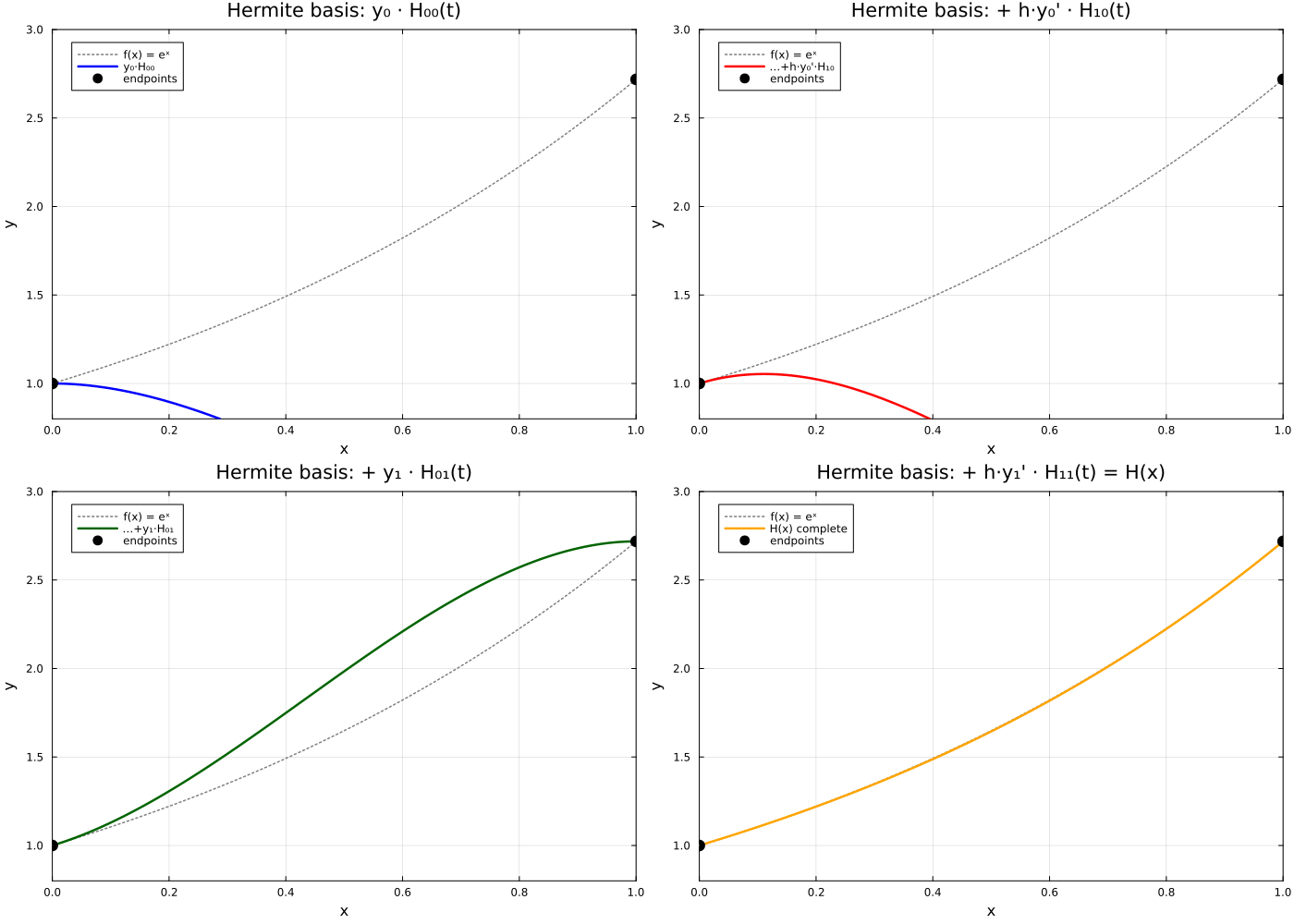
\[ H(x)=y_0H_{00}(t)+hy_0'H_{10}(t)+y_1H_{01}(t)+hy_1'H_{11}(t), \]
where \(H_{00},H_{10},H_{01},H_{11}\) are the standard cubic Hermite basis functions. In piecewise form over many subintervals, this gives a smooth \(C^1\) approximation that preserves both value and slope information at each node.
Animations
These animations illustrate the cubic Hermite polynomial, which interpolates both function values and first derivatives at the endpoint nodes. Unlike ordinary polynomial interpolation, Hermite interpolation matches the slope at each node, giving a smoother fit.
Julia source scripts that generated these animations are linked under each case.
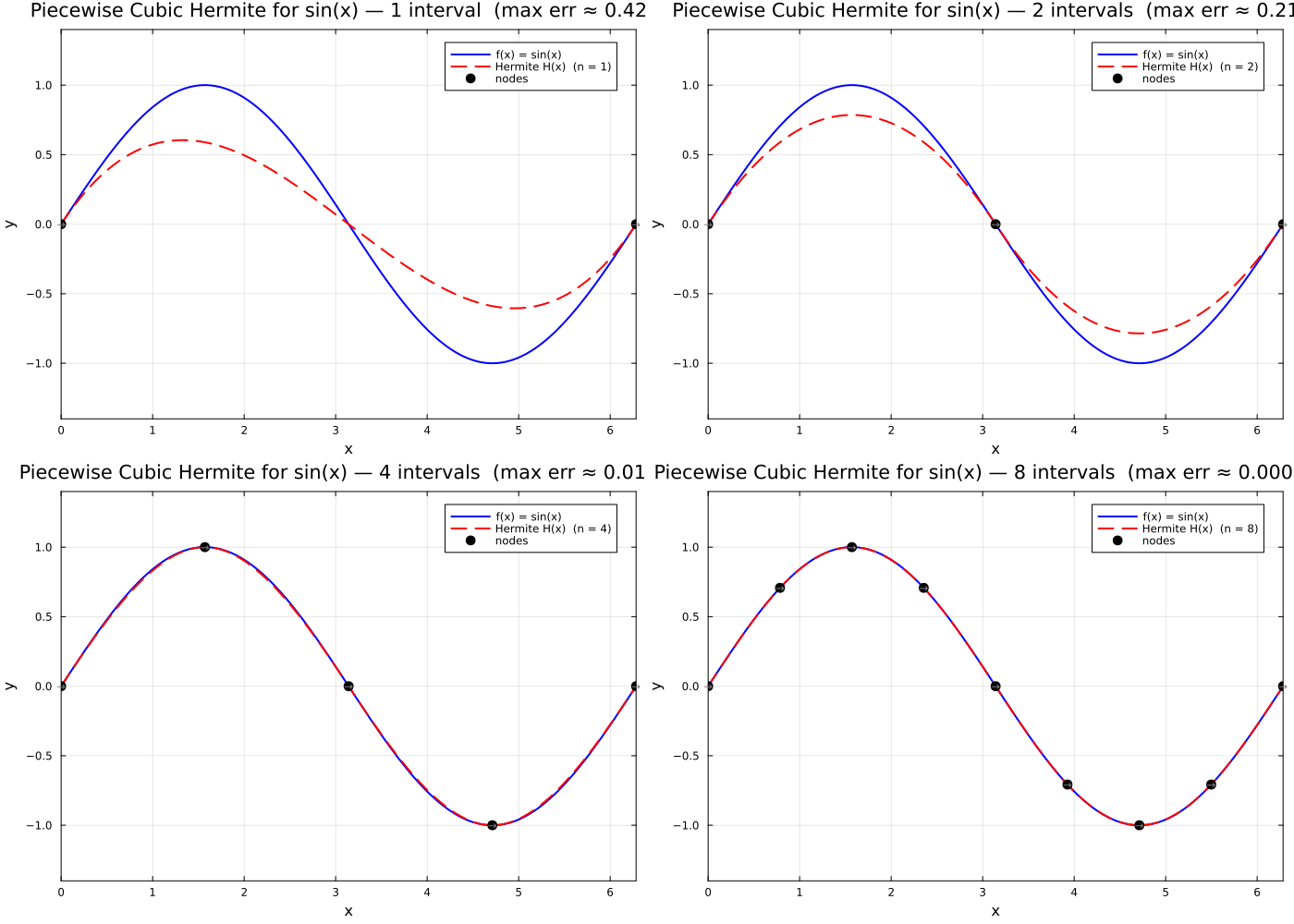
Case 1 — Piecewise cubic Hermite for \(\sin(x)\), refining the mesh
Behavior: Piecewise cubic Hermite interpolation uses \(n\) subintervals, each carrying a cubic polynomial that matches \(f\) and \(f'\) at its two endpoints. Doubling \(n\) decreases the maximum error by approximately \(2^4 = 16\), consistent with the \(O(h^4)\) convergence rate.
Case 2 — Hermite basis functions building the interpolant of \(e^x\) on \([0,1]\)
Behavior: The four cubic Hermite basis functions \(H_{00}\), \(H_{10}\), \(H_{01}\), \(H_{11}\) each carry one degree of freedom (a value or derivative at an endpoint). Their weighted combination \(H(x) = y_0 H_{00} + h y_0' H_{10} + y_1 H_{01} + h y_1' H_{11}\) equals the true function at both endpoints and matches the slope there.