Halley’s Method
Source inspiration: (Mathew 2000-2019).
Description
Halley’s method, attributed to Edmond Halley (1656–1742), is a root-finding algorithm that extends Newton-Raphson by incorporating the second derivative \(f''\). Where Newton-Raphson fits a tangent line at each iterate and finds its \(x\)-intercept, Halley’s method fits an osculating (second-order Taylor) parabola and finds the root of that parabola nearest to the current point. This extra curvature information yields cubic convergence at simple roots — the number of accurate digits roughly triples each iteration, compared to doubling for Newton-Raphson.
Iteration Formula
Given a smooth function \(f(x)\) with derivatives \(f'(x)\) and \(f''(x)\), the Halley iteration is:
\[x_{n+1} = x_n - \frac{2\, f(x_n)\, f'(x_n)}{2\bigl[f'(x_n)\bigr]^2 - f(x_n)\, f''(x_n)}\]
This can be rewritten to make the Newton-Raphson correction explicit:
\[x_{n+1} = x_n - \frac{f(x_n)}{f'(x_n)} \cdot \frac{1}{\displaystyle 1 - \frac{f(x_n)\, f''(x_n)}{2\bigl[f'(x_n)\bigr]^2}}\]
The bracketed factor is a multiplicative correction to the Newton step. When \(f''\) is small relative to \(f'\), the denominator is close to 1 and Halley reduces to Newton-Raphson.
Convergence
For a simple root \(x^*\) (where \(f(x^*) = 0\) and \(f'(x^*) \neq 0\)), Halley’s method converges with order 3:
\[|e_{n+1}| \approx C\,|e_n|^3, \qquad e_n = x_n - x^*\]
where the asymptotic error constant is
\[C = \left|\frac{f'''(x^*)}{6\,f'(x^*)} - \frac{\bigl[f''(x^*)\bigr]^2}{4\bigl[f'(x^*)\bigr]^2}\right|.\]
At a multiple root of order \(m \geq 2\), the cubic rate is lost and the method reverts to linear convergence (as with Newton-Raphson).
Trade-offs
Each Halley step requires three function evaluations — \(f\), \(f'\), and \(f''\) — versus two for Newton-Raphson. Whether the extra evaluation is worthwhile depends on the cost of computing \(f''\) and the required precision: for high-precision arithmetic (e.g., computing \(\sqrt{2}\) to hundreds of digits), Halley’s cubic rate makes it significantly faster overall.
Animations
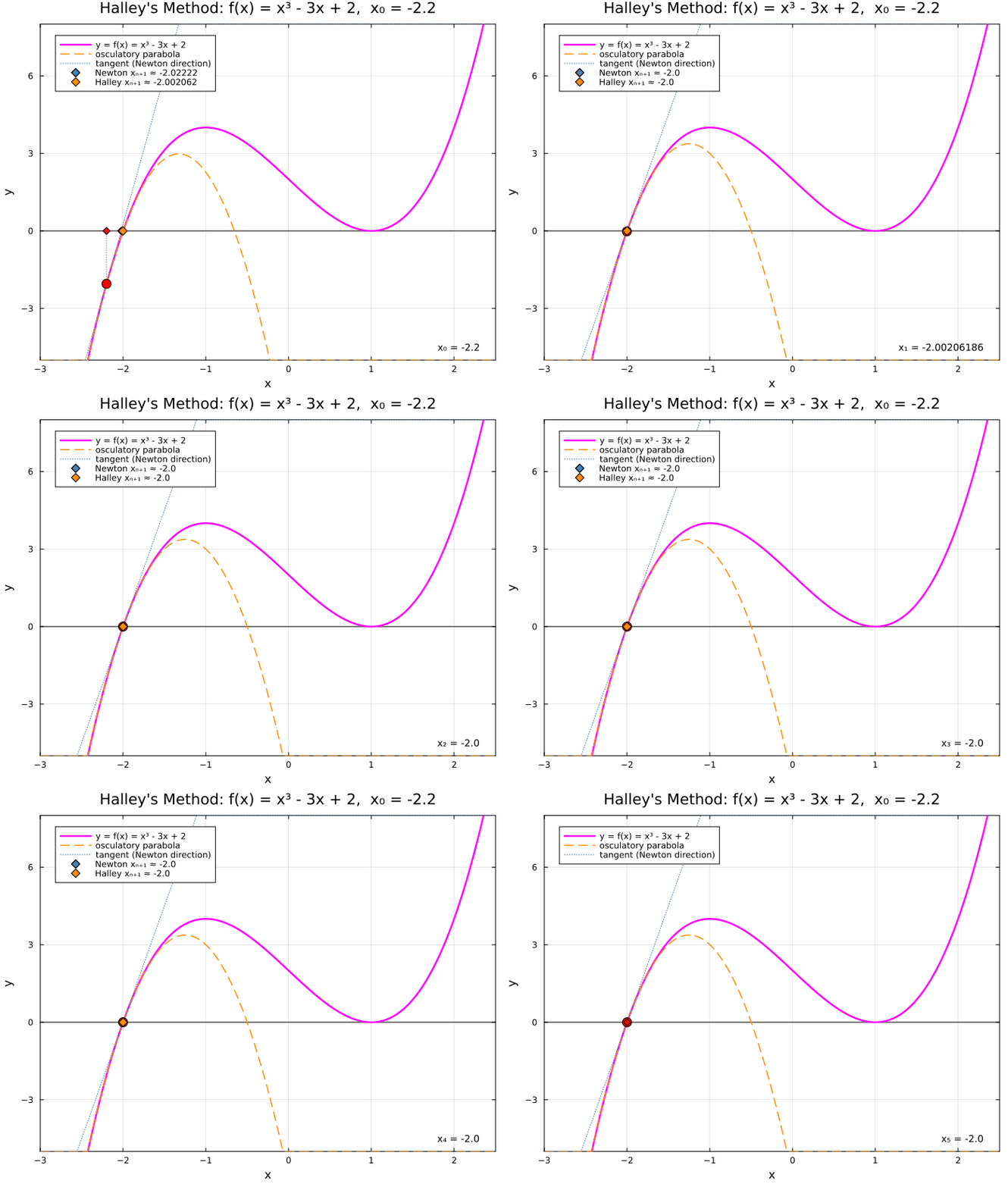
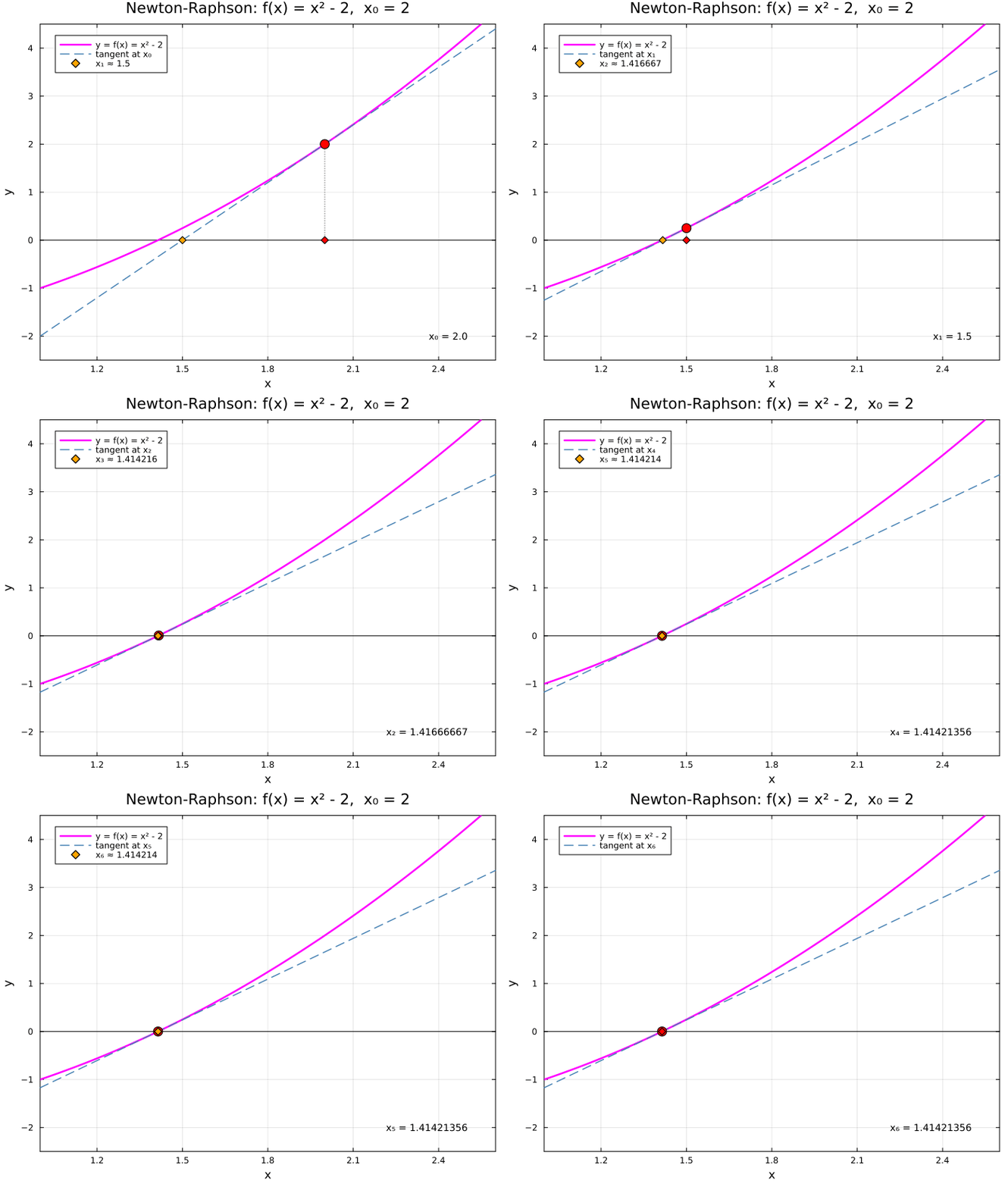
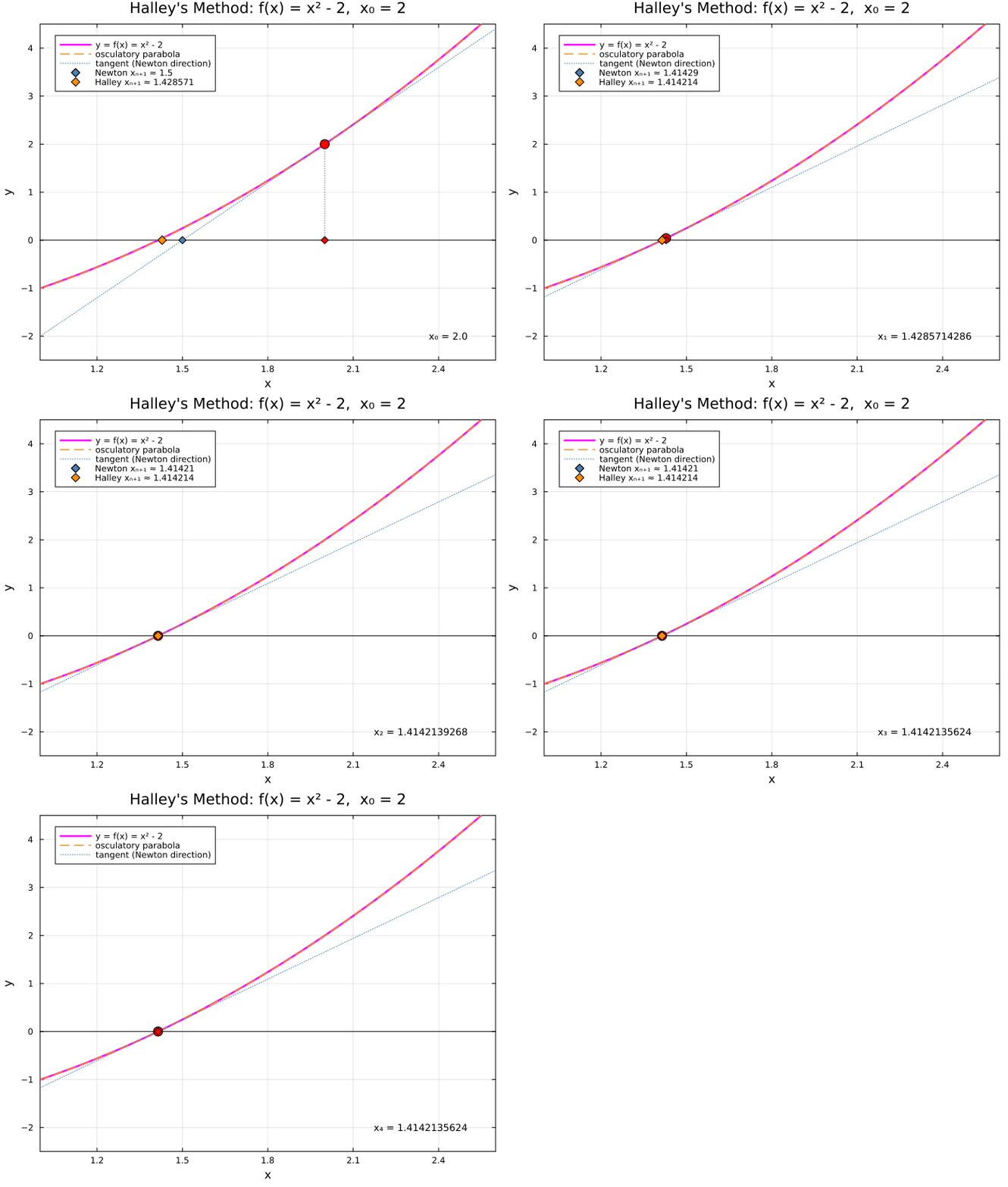
Each animation below illustrates the tangent-line and osculatory-parabola construction used by Newton-Raphson and Halley’s method. At each step, the current iterate \(x_n\) is marked on the curve; the tangent line (blue dotted) shows where Newton’s method would jump next, while the osculatory (second-order Taylor) parabola (orange dashed) shows Halley’s improved correction — yielding cubic rather than quadratic convergence at simple roots.
Julia source scripts that generated these animations are linked under each case.
Case 1a — Newton-Raphson baseline, \(f(x) = x^2 - 2\), \(x_0 = 2\)
Behavior: Starting at \(x_0 = 2\), the tangent at each iterate intersects the \(x\)-axis to produce the next iterate. The method converges quadratically to \(x^* = \sqrt{2} \approx 1.41421\), roughly doubling the number of correct digits per step (e.g., \(x_1 = 1.5\), \(x_2 \approx 1.4167\), \(x_3 \approx 1.4142\)).
Case 1b — Halley’s Method, \(f(x) = x^2 - 2\), \(x_0 = 2\)
Behavior: Starting at the same \(x_0 = 2\), Halley’s iteration uses both \(f'\) and \(f''\) to correct the Newton step. The orange diamond marks the Halley iterate; the blue diamond shows where Newton would land for comparison. Halley achieves \(x_1 \approx 1.42857\) in one step (vs Newton’s \(x_1 = 1.5\)), tripling accurate digits each iteration because $|g’’’(x^*)| / 3! $ governs the asymptotic error rather than \(|g''(x^*)| / 2!\).
Case 2 — Halley’s Method, \(f(x) = x^3 - 3x + 2\), \(x_0 = -2.2\)
Behavior: \(f(x) = x^3 - 3x + 2 = (x+2)(x-1)^2\) has a simple root at \(x = -2\) and a double root at \(x = 1\). Starting at \(x_0 = -2.2\) (near the simple root), Halley converges cubically: the first Halley step reaches \(x_1 \approx -2.002\), while Newton only reaches \(x_1 \approx -2.022\), demonstrating that Halley requires fewer iterations to attain high precision at simple roots. The orange dashed parabola visibly corrects the Newton overshoot.