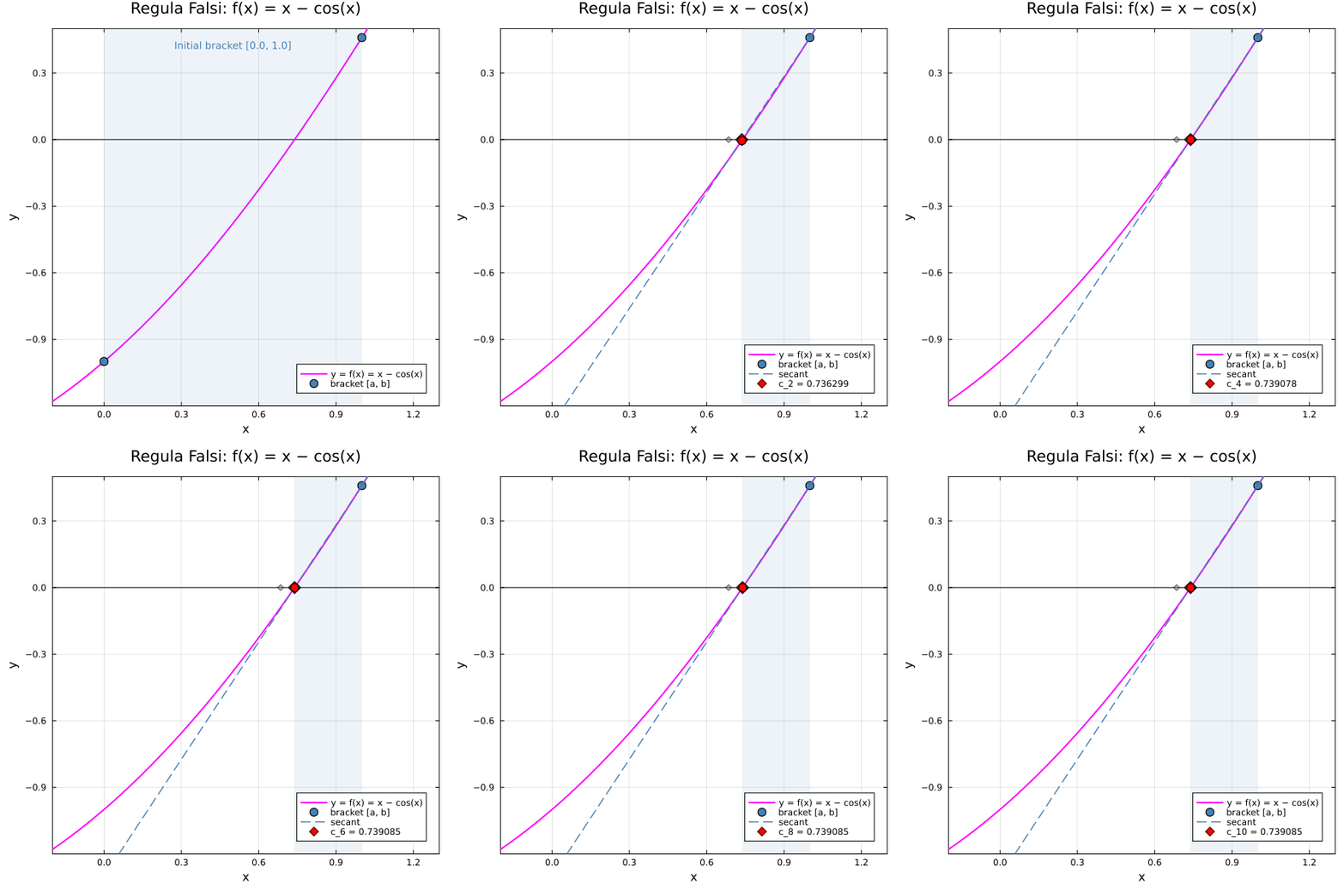
False Position or Regula Falsi Method
Source inspiration: (Mathew 2000-2019).
Animations
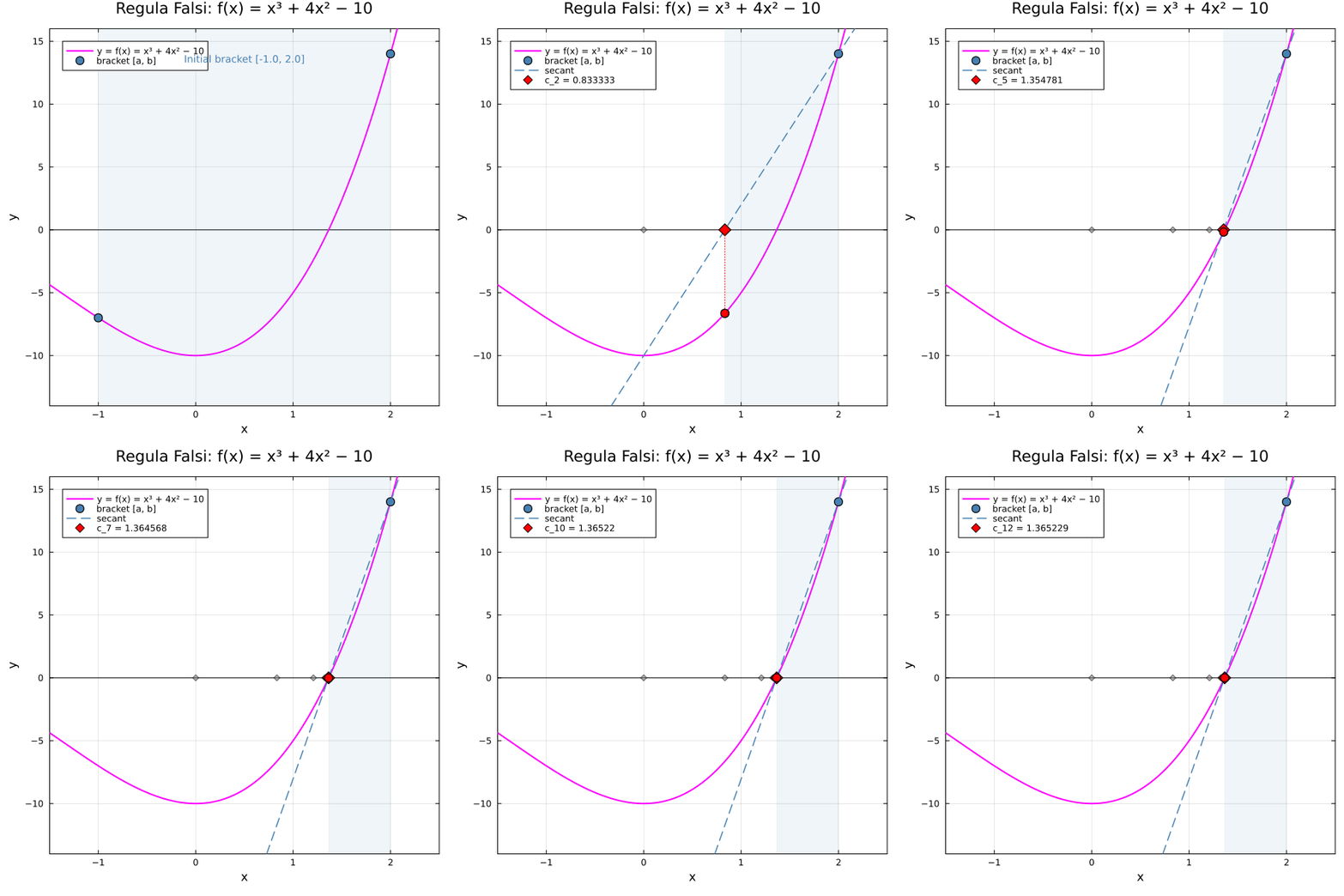
Each animation below shows the secant diagram for Regula Falsi. At each step, a secant line is drawn through the two bracket endpoints \((a, f(a))\) and \((b, f(b))\); its x-intercept \(c\) becomes the new estimate. Unlike bisection (which uses the midpoint), Regula Falsi weights the new point toward whichever endpoint has a smaller \(|f|\) value, often giving faster convergence — but one endpoint can remain fixed for many iterations.
Julia source scripts that generated these animations are linked under each case.
Case A — Convergent, \(f(x) = x^3 + 4x^2 - 10\), \([a, b] = [-1, 2]\)
Behavior: The method converges to the real root \(x^* \approx 1.3688\). The left endpoint \(a = -1\) stays fixed throughout because \(f(-1) < 0\) and all successive false-position points \(c\) also satisfy \(f(c) < 0\), so the algorithm keeps replacing \(a\) with \(c\) while \(b = 2\) holds. This “one-sided” stagnation is characteristic of Regula Falsi and distinguishes it from the symmetric bracketing of bisection.
Case B — Convergent (one-sided), \(f(x) = x - \cos(x)\), \([a, b] = [0, 1]\)
Behavior: The method converges to the “Dottie number” \(x^* \approx 0.7391\), the unique fixed point of cosine. The left endpoint \(a = 0\) remains fixed at \(f(0) = -1\) throughout, while successive false-position points advance from the right. This is a clean illustration of one-sided convergence: the bracket shrinks only on the right side, yet the secant intercept homes in on the root accurately.