Catenary
Source inspiration: (Mathew 2000-2019).
Animations
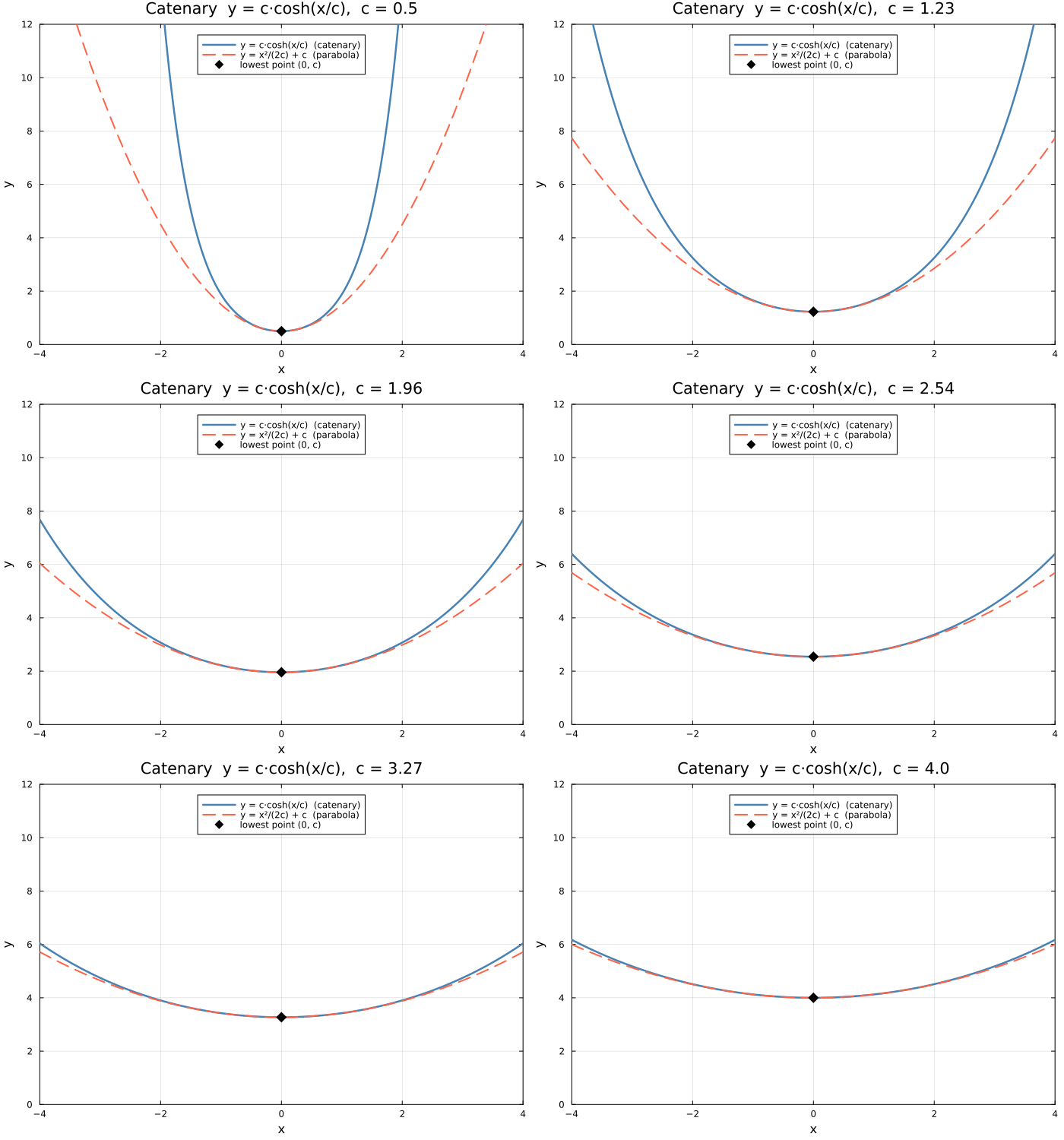
The animation below shows the catenary \(y = c\cosh(x/c)\) alongside its parabolic approximation \(y = x^2/(2c) + c\) as the sag parameter \(c\) increases from 0.5 to 4. The catenary is the curve formed by a flexible cable hanging under gravity; the parabola is the first two terms of its Maclaurin series.
Julia source scripts that generated these animations are linked under each case.
Case 1 — Catenary vs parabola approximation as \(c\) varies
Behavior: For large \(c\) (nearly taut cable), the two curves are nearly indistinguishable near \(x=0\). For small \(c\) (slack cable), the catenary hangs deeper and the parabola diverges noticeably at the endpoints. The lowest point is always at \((0, c)\).
Derivation Notes (Planned)
Short derivations will be added to explain the core equations and assumptions.