Boole’s Rule
Source inspiration: (Mathew 2000-2019).
Description
Composite Boole’s rule applies a quartic interpolant on each block of four subintervals (five nodes). For spacing \(h=(b-a)/n\) with \(n\) divisible by 4, \[ B_n = \frac{2h}{45}\sum_{k=0}^{n/4-1}\left(7f_{4k}+32f_{4k+1}+12f_{4k+2}+32f_{4k+3}+7f_{4k+4}\right). \]
The method is exact for polynomials up to degree 5 and has global error \(O(h^6)\) on smooth functions, making it the highest-order closed Newton-Cotes rule in this set.
Animations
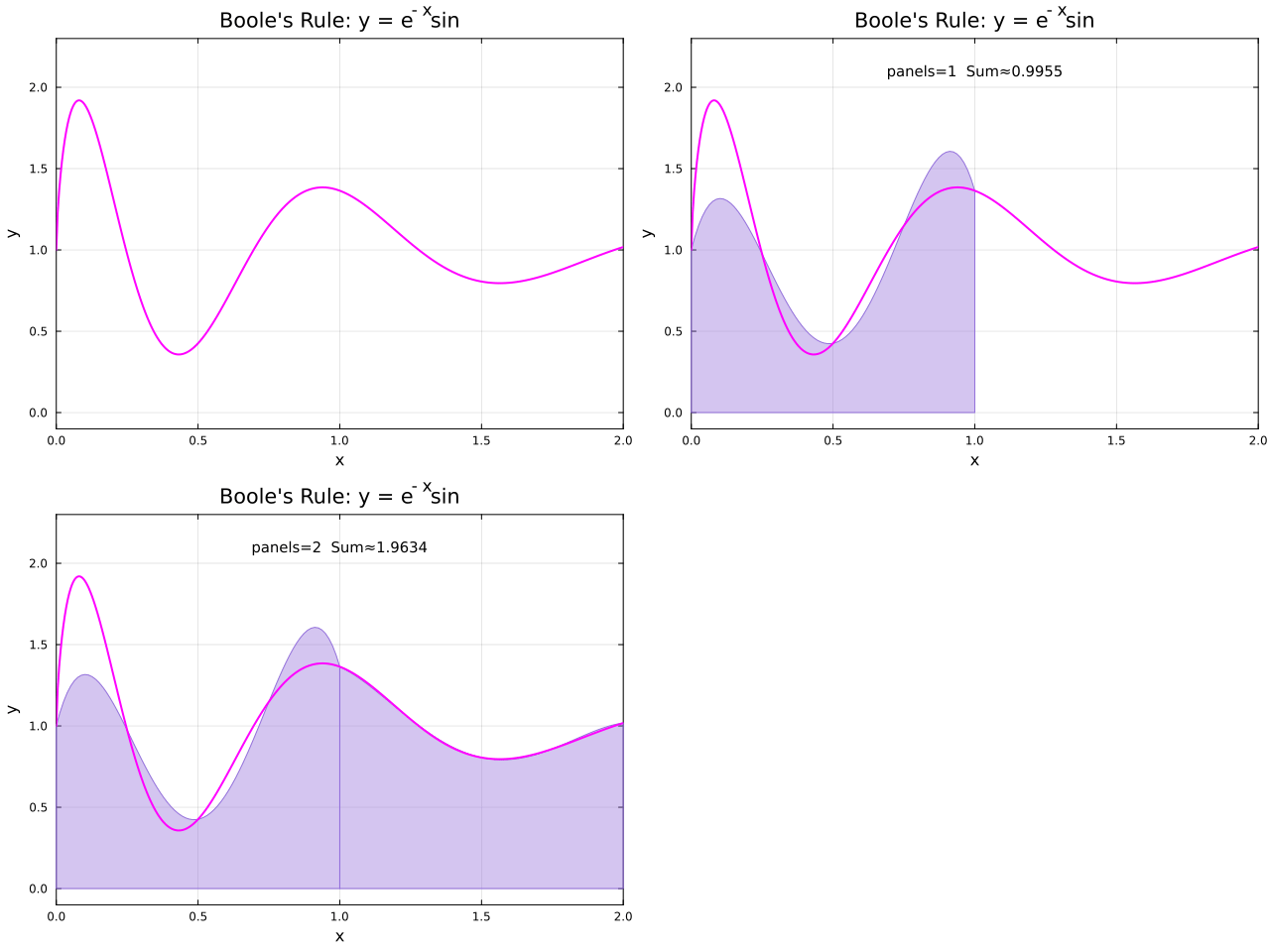
Each animation below shows the Boole’s rule diagram for \(f(x)=1+e^{-x}\sin(8x^{2/3})\) on \([0,2]\). Each frame recomputes the approximation over the full interval with a denser partition where \(n\) remains a multiple of 4.
Julia source scripts that generated these animations are linked under each case.
Case 1 — Composite Boole’s Rule, \(f(x)=1+e^{-x}\sin(8x^{2/3})\) on \([0,2]\)
Behavior: Piecewise quartic panels are rebuilt at increasing density, and the approximation converges rapidly with sixth-order global accuracy.
Derivation Notes (Planned)
Short derivations will be added to explain the core equations and assumptions.
Worked Example (Planned)
A compact numerical example with intermediate steps will be included.
Implementation Notes (Planned)
Implementation details, numerical stability notes, and practical pitfalls will be added.