Bisection Method
Source inspiration: (Mathew 2000-2019).
Animations
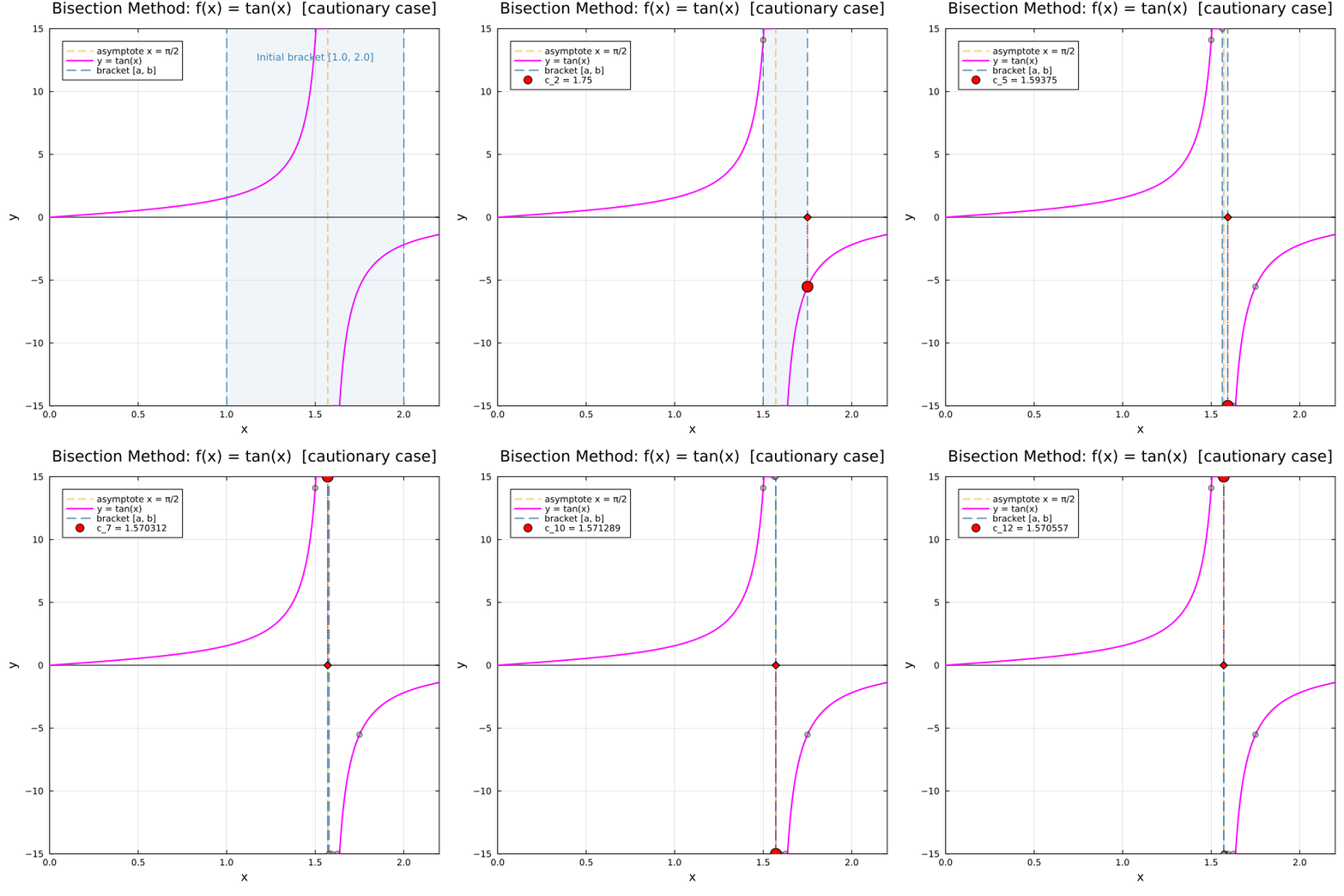
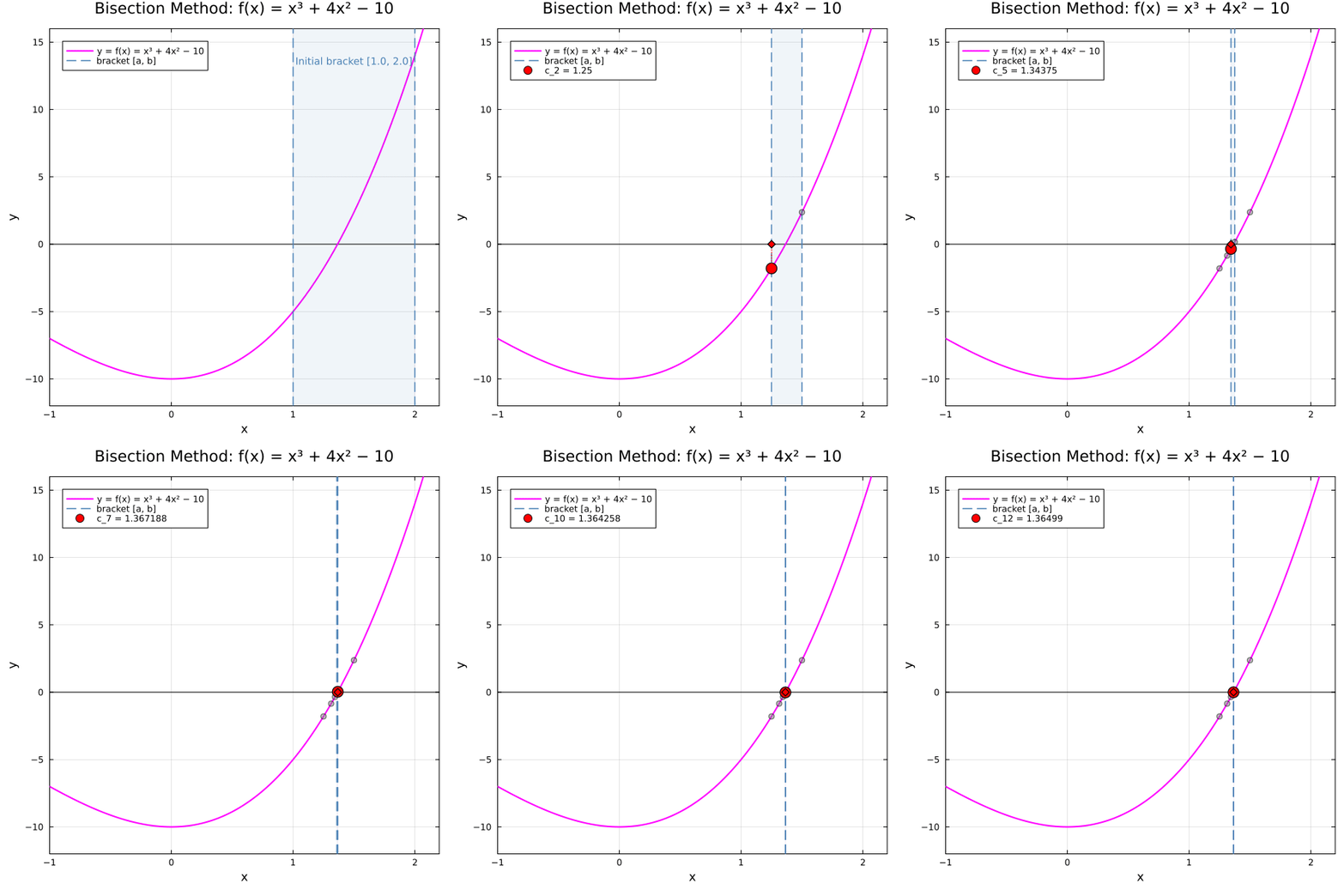
Each animation below shows the bracket-halving diagram for the bisection method. The shaded region marks the current bracket \([a, b]\) that is known to contain a root (by the Intermediate Value Theorem). Each frame computes the midpoint \(c = \tfrac{a+b}{2}\), evaluates \(f(c)\), and narrows the bracket to the half that still contains the sign change.
Julia source scripts that generated these animations are linked under each case.
Case 1 — Convergent, \(f(x) = x^3 + 4x^2 - 10\), \([a_0, b_0] = [1, 2]\)
Behavior: \(f(1) = -5 < 0\) and \(f(2) = 14 > 0\), so the IVT guarantees a root in \([1, 2]\). The true root is \(x^* \approx 1.3688\). The bracket halves each step and the midpoints converge monotonically.
Case 2 — Spurious convergence (cautionary), \(f(x) = \tan(x)\), \([a_0, b_0] = [1, 2]\)
Behavior: \(f(1) = \tan(1) > 0\) and \(f(2) = \tan(2) < 0\), so there is a sign change on \([1, 2]\). However, this sign change is caused by the vertical asymptote at \(x = \tfrac{\pi}{2} \approx 1.5708\), not a true root. Bisection converges to the asymptote — illustrating that the IVT guarantee requires \(f\) to be continuous on \([a, b]\).