Bézier Curves
Source inspiration: (Mathew 2000-2019).
Description
A Bezier curve of degree \(n\) with control points \(P_0,\ldots,P_n\) is defined by the Bernstein polynomial form
\[ B(t)=\sum_{i=0}^{n}\binom{n}{i}(1-t)^{n-i}t^iP_i,\qquad t\in[0,1]. \]
The curve starts at \(P_0\), ends at \(P_n\), and stays inside the convex hull of its control polygon. A numerically stable way to evaluate points on the curve is the de Casteljau algorithm, which repeatedly performs linear interpolation between adjacent points until one point remains.
Animations
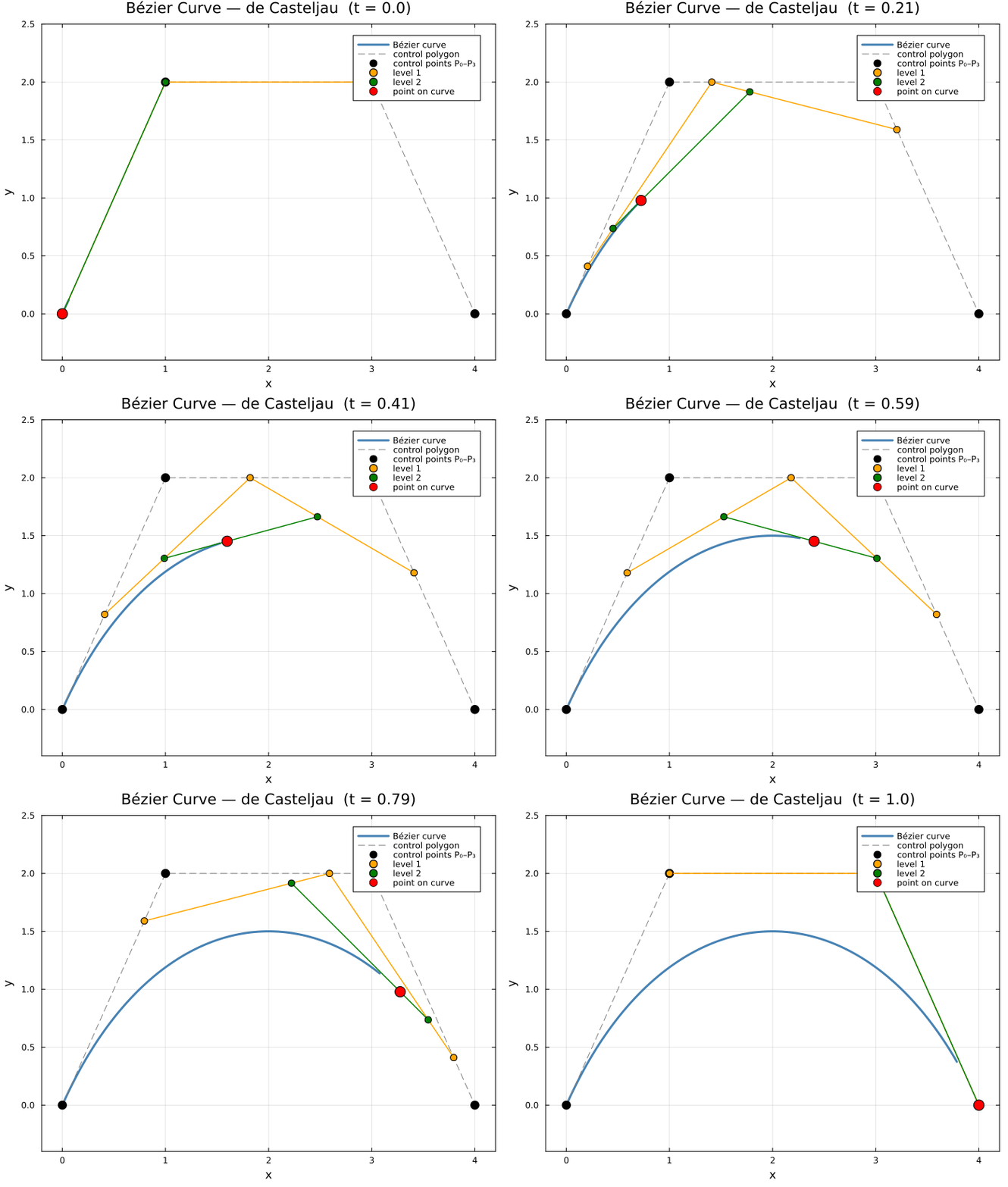
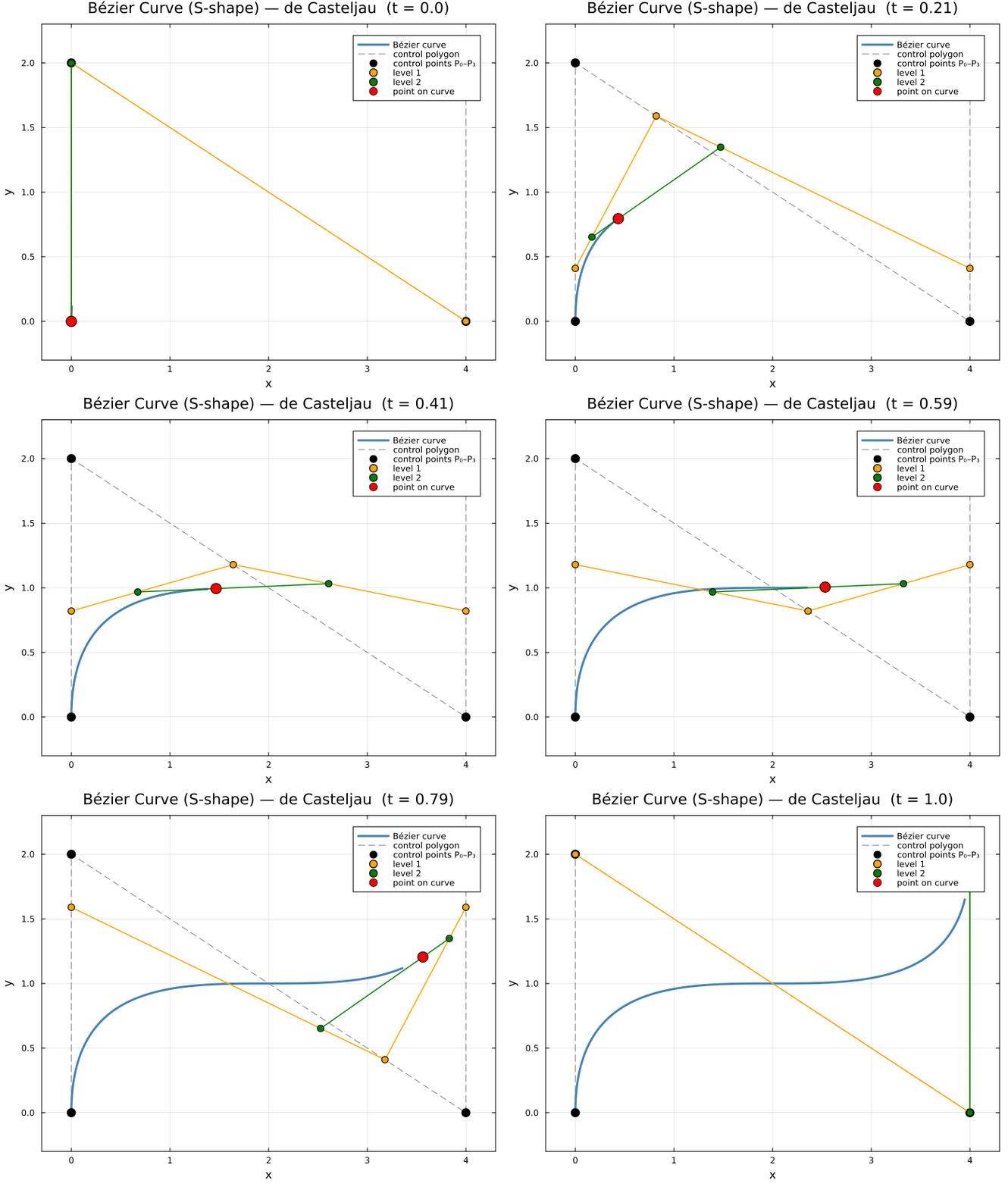
Each animation below demonstrates the de Casteljau algorithm for constructing a cubic Bézier curve. At parameter \(t\), the algorithm recursively linearly interpolates between adjacent control points through three successive levels until a single point on the curve is reached. Tracing this point for all \(t \in [0,1]\) draws the full curve.
Julia source scripts that generated these animations are linked under each case.
Case 1 — Arch-shaped cubic Bézier, \(P_0=(0,0)\), \(P_1=(1,2)\), \(P_2=(3,2)\), \(P_3=(4,0)\)
Behavior: The four control points define an arch. Level-1 (orange), level-2 (green), and curve (red) points are shown at each \(t\). As \(t\) goes from 0 to 1, the red point traces the smooth cubic Bézier curve from \(P_0\) to \(P_3\).
Case 2 — S-shaped cubic Bézier, \(P_0=(0,0)\), \(P_1=(0,2)\), \(P_2=(4,0)\), \(P_3=(4,2)\)
Behavior: The control points create an S-curve. The de Casteljau construction proceeds identically, but the resulting curve has an inflection point, illustrating how different control point arrangements produce qualitatively different shapes.
Derivation Notes (Planned)
Short derivations will be added to explain the core equations and assumptions.