B-Splines
Source inspiration: (Mathew 2000-2019).
Description
A B-spline curve of degree \(p\) is expressed as a weighted sum of control points and basis functions:
\[ C(t)=\sum_i P_i\,N_{i,p}(t). \]
The basis functions are defined recursively by the Cox-de Boor relation over a knot vector. Two key features make B-splines useful in geometric modeling: local support (moving one control point only affects a local region of the curve) and smoothness controlled by degree and knot multiplicity.
With a clamped knot vector, the curve interpolates the first and last control points while remaining inside the convex hull of the control polygon.
Animations
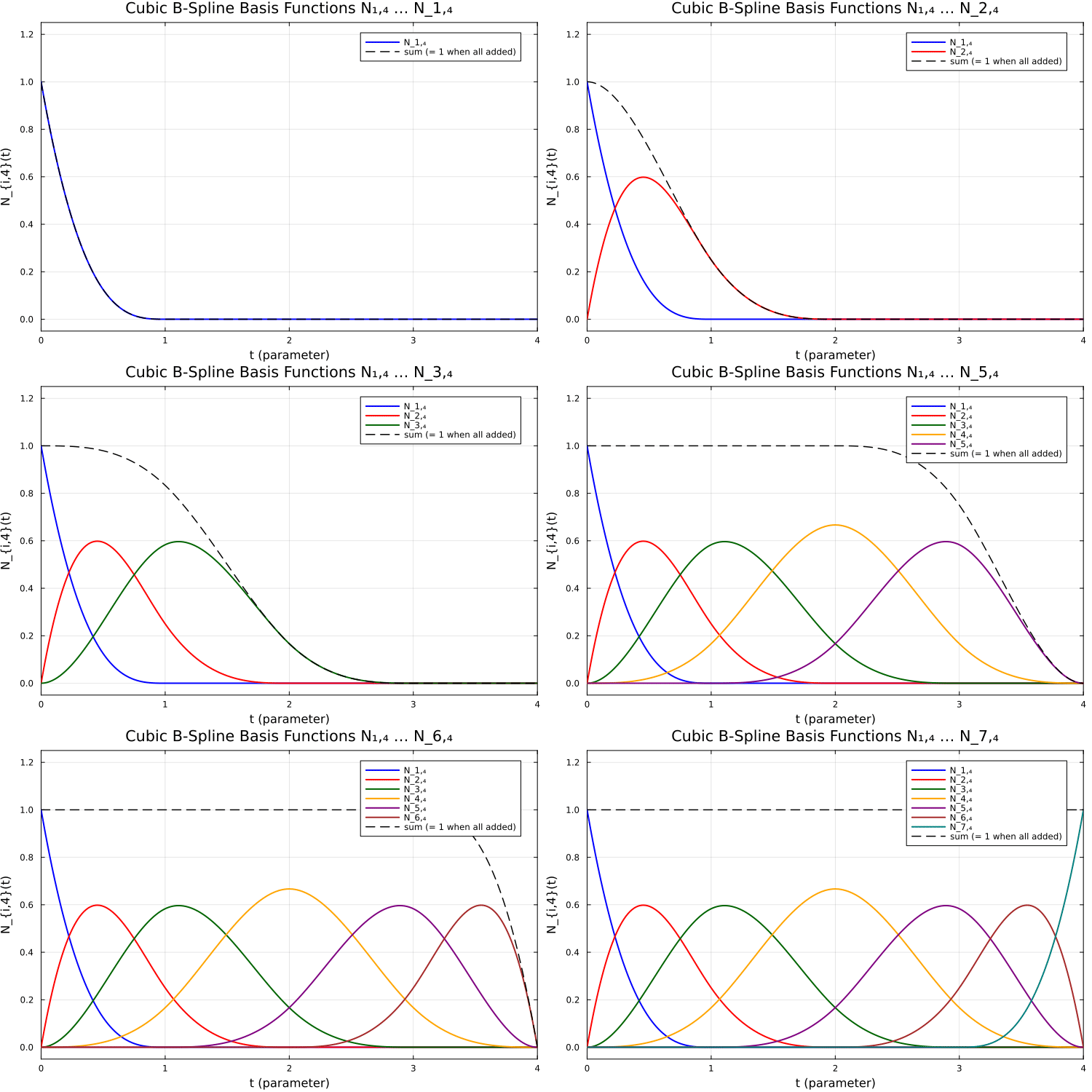
These animations show two complementary views of cubic B-splines: the smooth curve traced from control points, and the individual basis functions \(N_{i,4}(t)\) whose weighted sum defines the curve.
Julia source scripts that generated these animations are linked under each case.
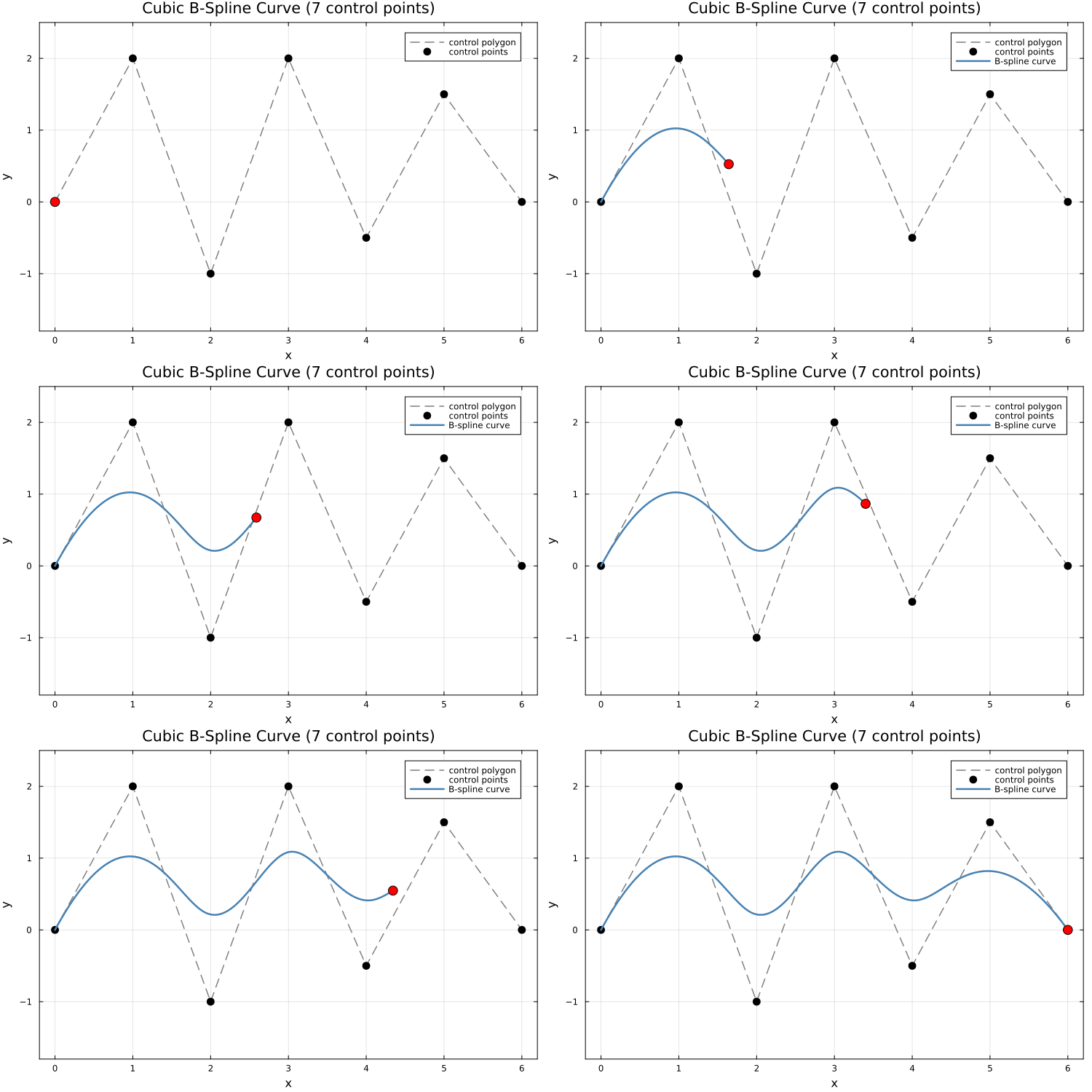
Case 1 — Cubic B-spline curve traced from 7 control points
Behavior: A cubic B-spline curve with a clamped knot vector passes through the first and last control points and is smoothly pulled toward the interior control points. The curve is \(C^2\)-continuous everywhere. The animation traces the curve parameter \(t\) from start to end.
Case 2 — Basis functions \(N_{1,4}, \ldots, N_{7,4}\) and the partition of unity
Behavior: Each cubic B-spline basis function \(N_{i,4}(t)\) is non-negative and has local support over exactly 4 knot spans. Their sum equals 1 everywhere in the domain (partition of unity), which is why the B-spline curve lies within the convex hull of the control polygon.