Aitken’s Method & Steffensen’s Acceleration
Source inspiration: (Mathew 2000-2019).
Description
The Problem: Linear Convergence at Multiple Roots
Newton–Raphson’s method converges quadratically at simple roots — the number of correct decimal digits roughly doubles each iteration. However, at a multiple root of order \(m \geq 2\), convergence degrades to linear: the error satisfies
\[ \lim_{k \to \infty} \frac{|x_{k+1} - p|}{|x_k - p|} = \frac{m - 1}{m} \]
For a double root (\(m = 2\)) the ratio is \(\tfrac{1}{2}\), meaning each Newton step only halves the error — hundreds of iterations may be needed to reach machine precision.
Aitken’s \(\Delta^2\) Process
Given any linearly convergent sequence \(\{x_k\}\) converging to a limit \(p\) (not just Newton iterates), Aitken’s process constructs an accelerated sequence \(\{\hat{x}_k\}\) that converges faster than the original. Define the forward difference operator \(\Delta x_k = x_{k+1} - x_k\) and the second difference \(\Delta^2 x_k = x_{k+2} - 2x_{k+1} + x_k\). Then
\[ \hat{x}_k = x_k - \frac{(\Delta x_k)^2}{\Delta^2 x_k} = x_k - \frac{(x_{k+1} - x_k)^2}{x_{k+2} - 2x_{k+1} + x_k} \]
Theorem (Aitken Acceleration). If \(\{x_k\} \to p\) linearly with \(x_k \neq p\) for all \(k\), then
\[ \lim_{k \to \infty} \frac{\hat{x}_k - p}{x_k - p} = 0 \]
i.e. \(\{\hat{x}_k\}\) converges to \(p\) faster than \(\{x_k\}\) in the sense that the ratio of errors goes to zero.
Steffensen’s Acceleration Method
Steffensen’s method applies Aitken’s \(\Delta^2\) process directly to the Newton iteration to create a self-contained algorithm that achieves superlinear convergence even at double roots. Starting from \(p_0\):
- Compute two Newton steps: \(\displaystyle q_1 = p_0 - \frac{f(p_0)}{f'(p_0)}\), \(\quad q_2 = q_1 - \frac{f(q_1)}{f'(q_1)}\)
- Apply Aitken’s formula: \(\displaystyle p_1 = p_0 - \frac{(q_1 - p_0)^2}{q_2 - 2q_1 + p_0}\)
- Set \(p_0 \leftarrow p_1\) and repeat.
Each outer iteration consumes two Newton steps but produces a correction that is far more accurate than either step alone. The combined effect restores roughly quadratic convergence at roots where unaided Newton would only converge linearly.
Summary Comparison
| Method | Root type | Convergence order | Notes |
|---|---|---|---|
| Newton–Raphson | Simple (\(m=1\)) | Quadratic (\(\approx 2\)) | Standard |
| Newton–Raphson | Double (\(m=2\)) | Linear (\(\tfrac{1}{2}\)) | Very slow |
| Steffensen | Double (\(m=2\)) | Superlinear (\(\approx 2\)) | Two Newton evals per step |
Animations
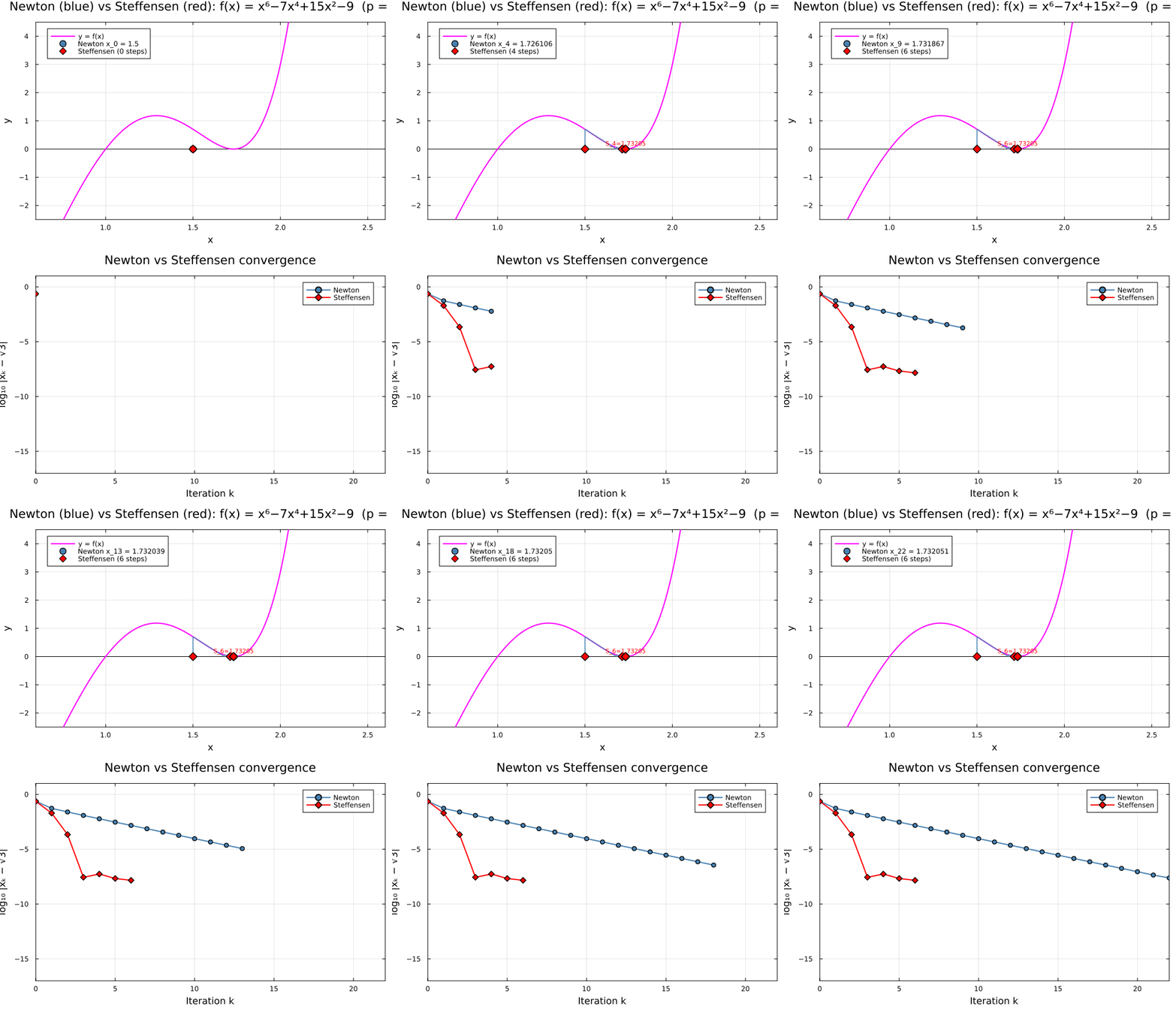
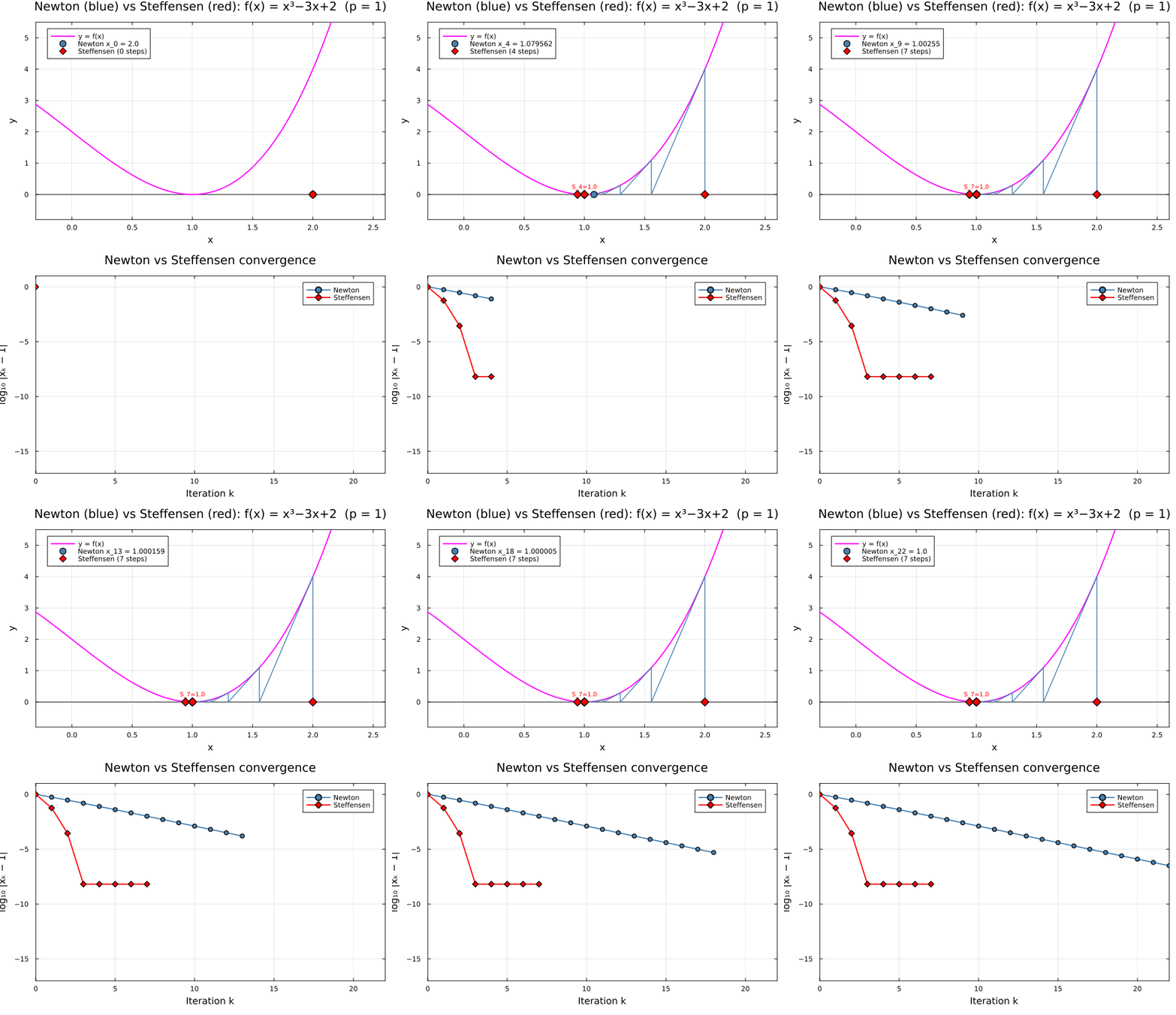
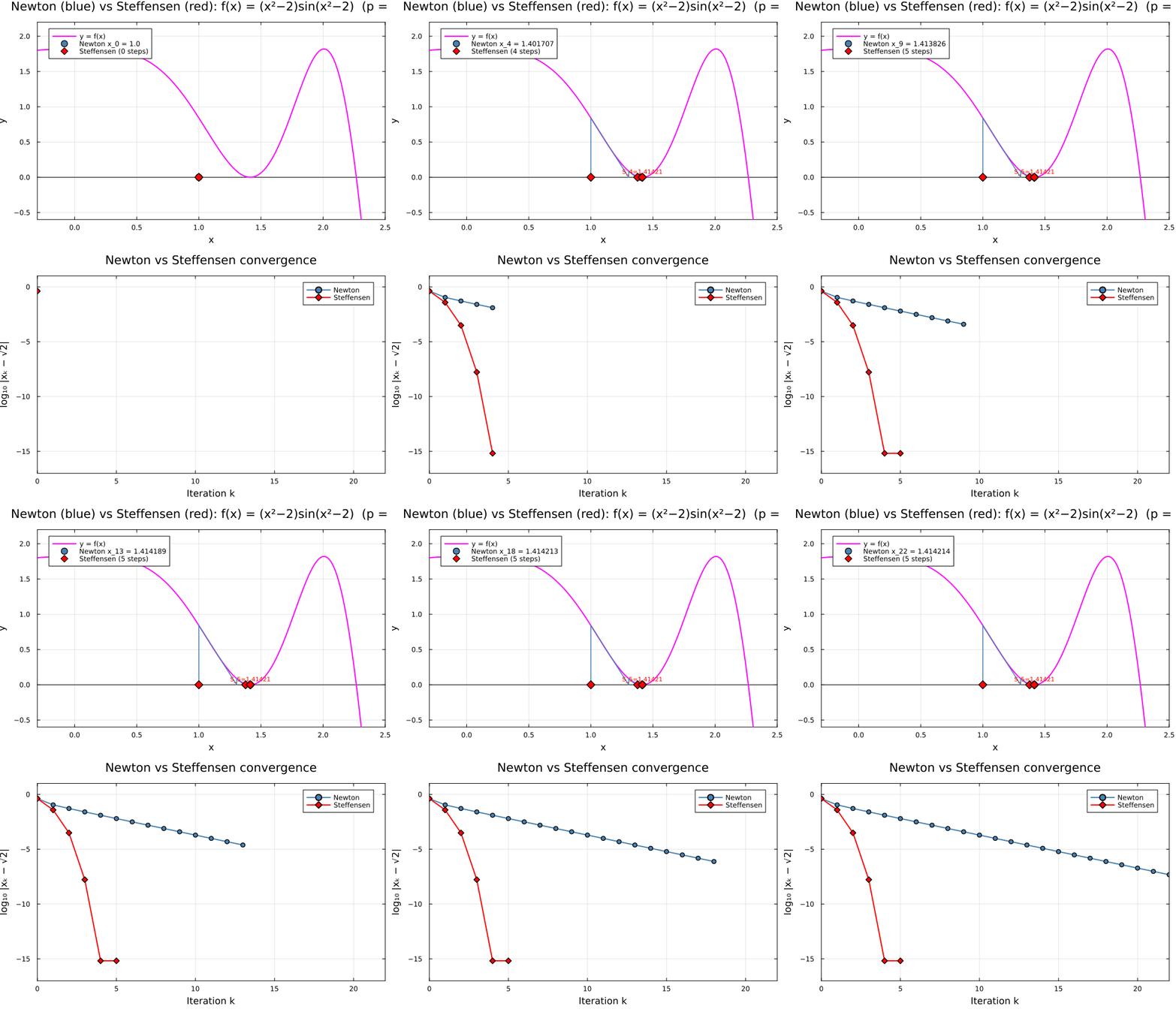
Each animation below shows two synchronized panels for a given function: the top panel traces Newton–Raphson’s tangent-line geometry (one step per frame), and the bottom panel plots \(\log_{10}|x_k - p|\) vs. iteration count for both Newton and Steffensen side by side. Because both panels share the same frame clock, you can directly compare where Newton is geometrically with how fast each method is converging numerically.
Julia source scripts that generated these animations are linked under each case.
Case 1 — \(f(x) = x^3 - 3x + 2\), double root \(p = 1\), \(x_0 = 2.0\)
Behavior: Newton–Raphson converges linearly (slowly) to the double root \(p = 1\) of \(f(x) = (x-1)^2(x+2)\). At a double root the asymptotic error ratio is \(\tfrac{1}{2}\), so each step only halves the error. Steffensen’s \(\Delta^2\) acceleration restores superlinear convergence, reaching machine precision in a handful of steps.
Case 2 — \(f(x) = (x^2-2)\sin(x^2-2)\), double root \(p = \sqrt{2}\), \(x_0 = 1.0\)
Behavior: The double root \(p = \sqrt{2}\) causes Newton to converge linearly. Steffensen’s acceleration applied to the Newton iterates recovers rapid convergence, dropping to machine precision far sooner.
Case 3 — \(f(x) = x^6 - 7x^4 + 15x^2 - 9\), double root \(p = \sqrt{3}\), \(x_0 = 1.5\)
Behavior: \(f(x) = (x^2-1)(x^2-3)^2\) has a double root at \(p = \sqrt{3} \approx 1.732\). Newton’s linear crawl is visible in both the tangent-line panel and the gently sloping error curve; Steffensen converges in only a few Aitken-accelerated steps.