Accelerated & Modified Newton-Raphson
Source inspiration: (Mathew 2000-2019).
Description
Standard Newton-Raphson converges quadratically at simple roots but degrades to linear convergence at multiple roots, because \(f'(x^*) = 0\) there. Two methods restore quadratic convergence.
Accelerated Newton-Raphson (Method A) multiplies the Newton step by the known root multiplicity \(m\): \[x_{n+1} = x_n - m \cdot \frac{f(x_n)}{f'(x_n)}\] This compensates for the vanishing derivative and recovers the quadratic rate. It requires knowing \(m\) in advance.
Modified Newton-Raphson (Method B) avoids needing \(m\) by reformulating the problem. If \(f\) has a root of multiplicity \(m\) at \(x^*\), then \(h(x) = f(x)/f'(x)\) has a simple root at \(x^*\). Applying Newton’s method to \(h\) gives: \[x_{n+1} = x_n - \frac{f(x_n)\,f'(x_n)}{f'(x_n)^2 - f(x_n)\,f''(x_n)}\] This also converges quadratically, without knowing \(m\).
Both methods require that \(f\) be sufficiently smooth near the root and that the starting point \(x_0\) be close enough to \(x^*\).
Animations
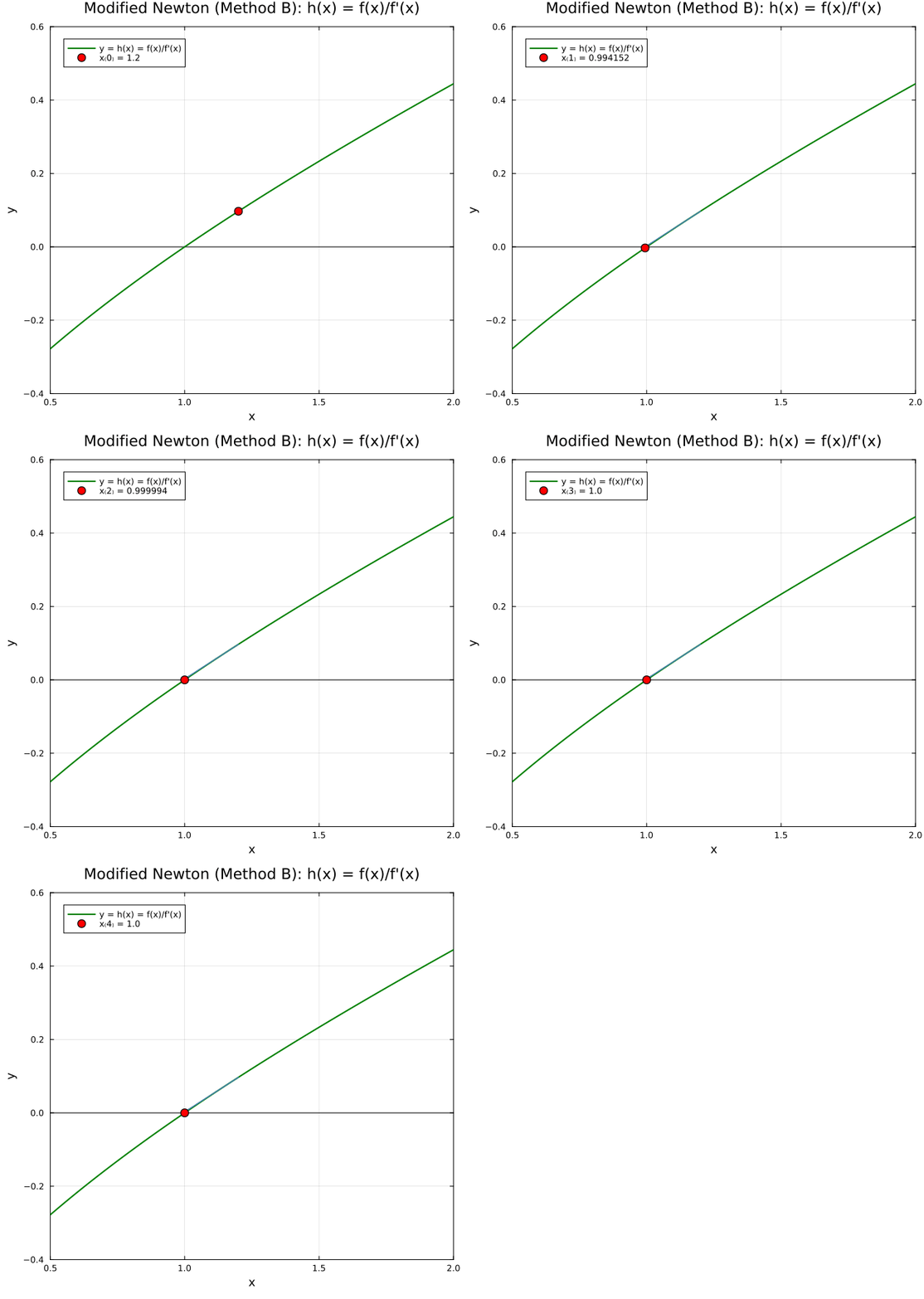
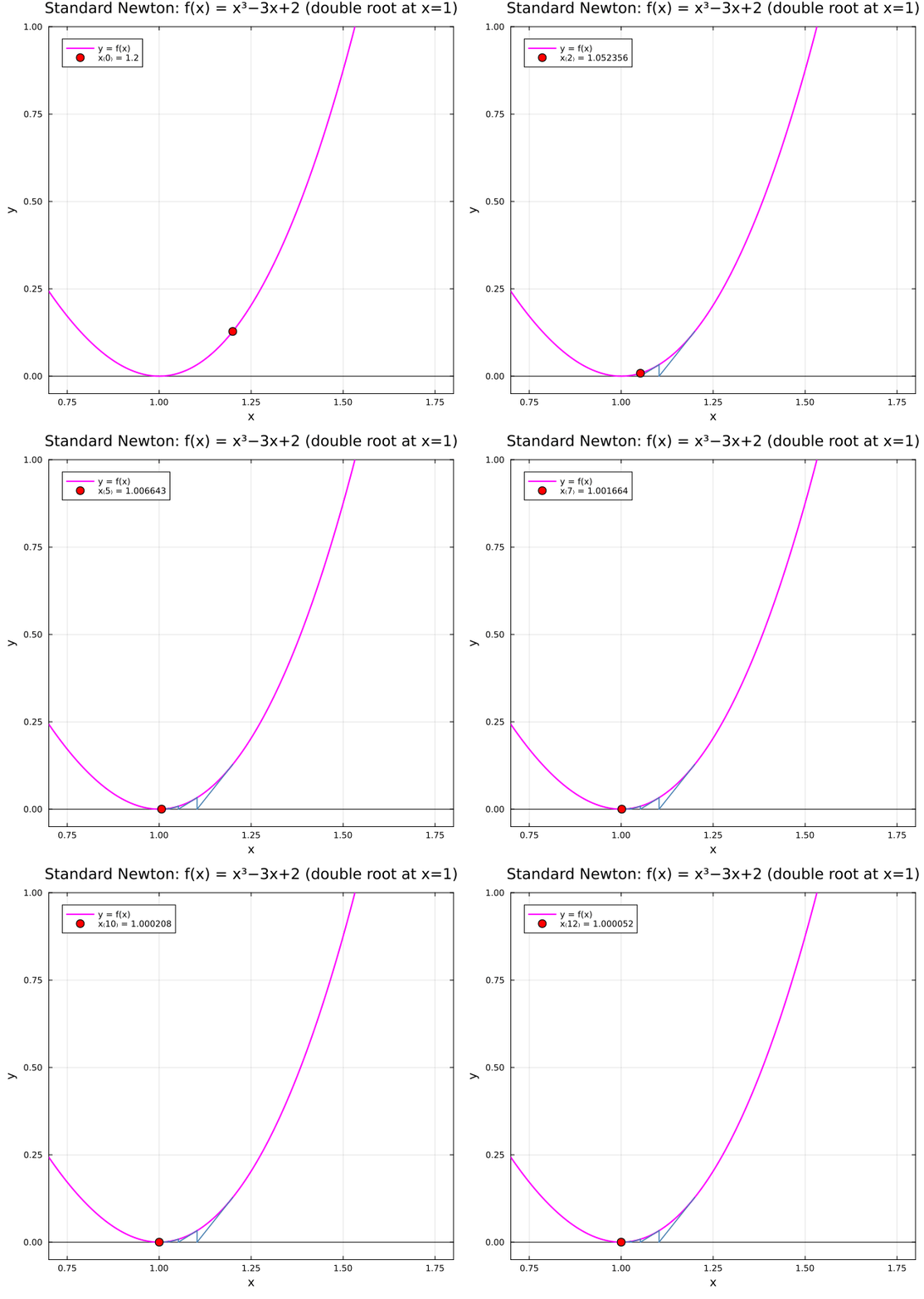
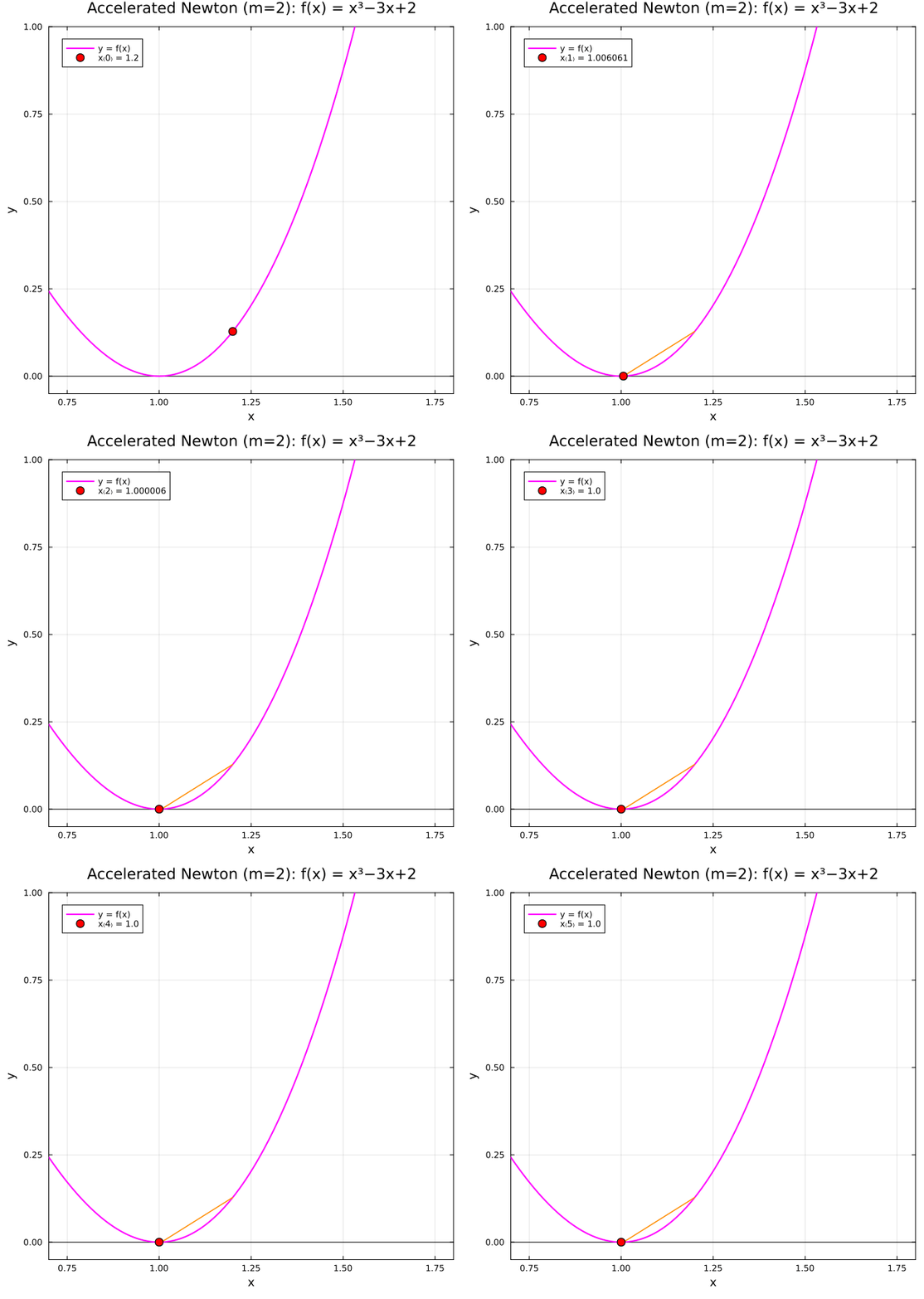
Each animation below shows the Newton tangent-line diagram for three methods applied to the same double root. At each iterate \(x_n\), the line from \((x_n,\, f(x_n))\) to the x-axis intercept traces the next approximation \(x_{n+1}\). Cases 1 and 2 both plot \(f(x)\); Case 3 plots \(h(x) = f(x)/f'(x)\), which has a simple root where \(f\) has a double root.
Julia source scripts that generated these animations are linked under each case.
Case 1 — Standard Newton-Raphson, linear convergence, \(f(x) = x^3 - 3x + 2\), \(x_0 = 1.2\)
Behavior: \(f(x) = (x-1)^2(x+2)\) has a double root at \(x^* = 1\). Because \(f'(x^*) = 0\) at a multiple root, the asymptotic error constant is \((m-1)/m = 1/2\), meaning each step only halves the error. The tangent line at \(x_n\) is nearly horizontal near the root, so it crosses zero far from \(x^*\) — forcing many iterations to creep toward \(x = 1\).
Case 2 — Accelerated Newton-Raphson (Method A, \(m=2\)), quadratic convergence, \(f(x) = x^3 - 3x + 2\), \(x_0 = 1.2\)
Behavior: The accelerated formula \(x_{n+1} = x_n - m \cdot \tfrac{f(x_n)}{f'(x_n)}\) with \(m = 2\) enlarges each Newton step by the known multiplicity, compensating for the vanishing derivative at the double root. This restores quadratic convergence: \(|e_{n+1}| \approx C |e_n|^2\). The same function and starting point as Case 1 now converges in just a few steps. Requires knowing \(m\) in advance.
Case 3 — Modified Newton-Raphson (Method B), quadratic convergence, \(f(x) = x^3 - 3x + 2\), \(x_0 = 1.2\)
Behavior: Define \(h(x) = f(x)/f'(x)\). At a double root of \(f\), \(h\) has a simple root — so standard Newton on \(h\) gives quadratic convergence. The iteration formula \[x_{n+1} = x_n - \frac{f(x_n)\,f'(x_n)}{f'(x_n)^2 - f(x_n)\,f''(x_n)}\] implements Newton on \(h(x)\) using \(f\), \(f'\), and \(f''\) directly. The animation plots \(h(x) = (x-1)(x+2)/(3(x+1))\) and shows the tangent lines converging to \(x = 1\) in just 2 steps. Does not require knowing \(m\).